
Last Updated on August 23, 2026 by Team TBH
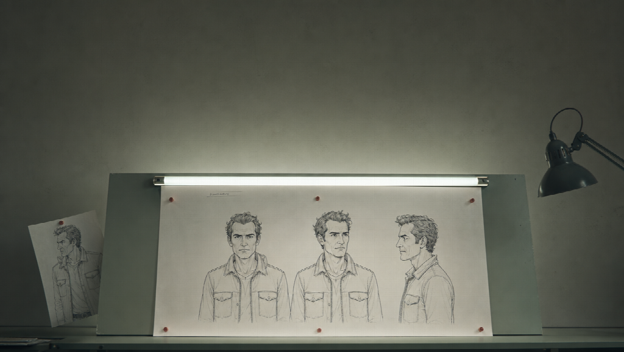
A character can look perfect in shot one and become a cousin in shot four. Hairline drifts. The jacket gains a zipper. A side angle invents a new nose. That is still the most expensive failure in AI video — not because teams cannot find a “good” model, but because they treat consistency as a single generate-button feature.
Most 2026 bake-offs test one 15-second prompt and one reference still. That is a useful lab. It is not a series. A travel vlog, a vertical drama, a founder serial, or a branded mascot has to survive camera changes inside a clip and episode changes across a week. Those are different jobs. One belongs to a multimodal generation model. The other belongs to a character bible that does not live in a chat transcript.
This article is a stack guide: why faces still break, what a longer reference-led model can lock inside one beat, and why short-drama workbenches exist for everything that has to come back on Thursday.
Why faces still slip
Identity drift inside a clip
The model starts from a clear front portrait, then a café window and a close-up arrive. Lighting changes. The network interpolates. Without a fat, non-conflicting kit — face, three-quarter, outfit — it averages. Viewers call it “off.” They do not say “latent drift.”
New angle, new person
Front-facing stills are easy. Over-the-shoulder, profile, and extreme close-up are where many short-clip tools mint a second lead. If you only ever fed one beauty still, you asked for that.
Wardrobe and props go first
Even when the skull holds, logos melt, backpacks teleport, jewelry migrates. Clothing is high-frequency detail. It needs its own reference and a negative line: no new zippers, no extra badges.
Episode two is a different failure
Winning a 15-second test does not mean episode two remembers the café wallpaper. Chat history is not a cast list. If the look lives only in last week’s prompt, it will be rewritten.
Two layers: the beat, then the bible
Do not rank a model against a studio. One executes a timed scene. One stores the people and places so the next scene can reuse them.
Layer 1 — lock the 15–30 second beat
When the job is one continuous story beat — street, café, laptop, smile — stitching five eight-second orphans is how you manufacture drift at every cut.
Seedance 2.5 is a multimodal AI video model for coherent clips up to about thirty seconds from text plus image, video, and audio references, with timing and storyboard-friendly direction. That maps to the consistency test creators actually fail: same face and outfit across camera moves inside one pass, not after an editor hides the joins.
Use it when you already have a kit: a hero portrait, an outfit still, optional motion or voice. Write intervals (“0–5s wide walk, 5–12s café order, 12–22s window, 22–30s close-up — same white jacket, same backpack, no new jewelry”). Review identity before beauty. If second eighteen grows a new collar, fix the kit. Do not buy a higher “cinematic” adjective.
Kling-class motion tools, Veo-class photoreal lanes, and Runway-class suites still win specific inserts. They are not automatically a 30-second identity engine, and they do not remember episode three.
Layer 2 — store the cast so Thursday still matches Monday
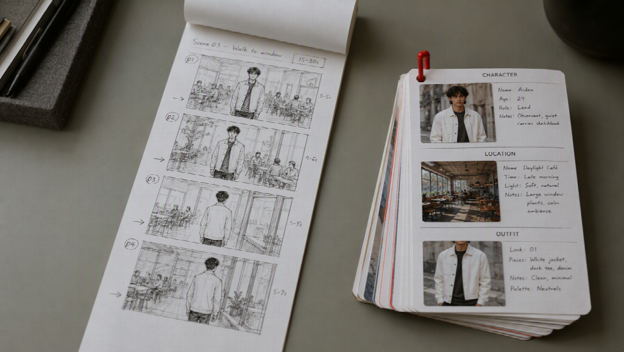
A reference sheet in a Downloads folder will lose to a new chat. Serialized vertical drama, web-fiction adaptations, and mascot channels need records: character cards, locations, props, outfits as plot points, beat sheets.
Drama Studio is Topview’s short-drama workbench for that memory layer: start from an idea, outline, script, or novel chapter; keep characters, locations, props, and boards in one project; storyboard; then send approved beats to generation. Create the lead once. If the plot changes clothes, that is a second labeled look — not a mixed folder of two jackets.
Approve the bible before you spend credits on motion. The agent can draft structure. You lock hair, age range, and the one outfit for this episode.
A practical character package (before any video)
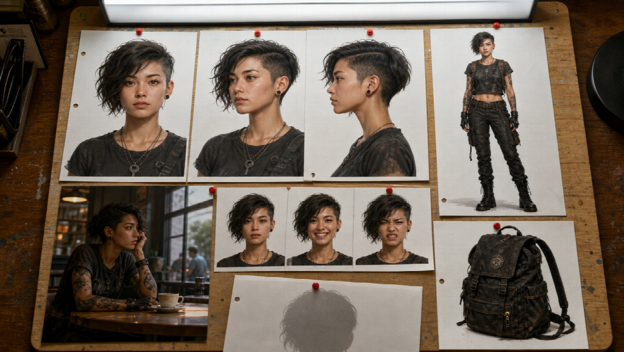
You do not need a feature-film art department. You need enough views that a new angle is not a guess.
- Front portrait, three-quarter, and one profile
- Full-body in the default costume
- One expression sheet (neutral, smile, tension)
- Location stills you will reuse
- Props the camera must recognize again
Same files in the workbench and in the Seedance 2.5 reference slots. Conflicting doubles — two haircuts, two apartments — are an argument the model will settle badly.
How to run a consistency pass
- Write the identity line the model must obey, including negatives.
- Board the camera order so you are not asking for a profile you never showed.
- Generate the beat in one longer pass when the story needs a continuous 15–30 seconds.
- Score the take on face, outfit, bag, room — not on whether the sunset is pretty.
- Return the winner to the project so episode two starts from records, not from memory.
If a close-up fails, add a tighter face still and reroll that interval. If episode two fails, you skipped the bible, not the “best model” list.
Final thoughts
Character consistency has improved. Bake-offs that crown a single winner for a 15-second Tokyo vlog still miss the production question: can this person come back?
For one directed beat with a fat kit, a longer multimodal model such as Seedance 2.5 is the right execution lane. For a series that has to look like the same show next week, Drama Studio is the records layer. Preparation — sheets, one default outfit, boards before video — still moves the needle more than swapping homepages.
The stack is boring. That is why it works.
FAQ
What is character consistency?
Keeping face, hair, body, and costume stable across shots and, for series, across episodes.
Is image-to-video better than text-to-video for identity?
Usually yes. A still is a lock. A prompt is a wish. Best results combine both: image kit plus a timed brief.
How many references?
For a professional beat: at least front, three-quarter, full-body outfit. More is useful until two files contradict each other.
Can I skip a workbench Yes. Skip it if you truly will never reuse the person. Do not skip it if you already know there is an episode two.
To read more content like this, explore The Brand Hopper
Subscribe to our newsletter