Last Updated on September 10, 2026 by Team TBH
Choosing an ecommerce platform is one of the most consequential decisions a small business owner makes, and Shopify versus WooCommerce is the comparison that comes up more than almost any other.
Both platforms power millions of online stores, both have passionate communities, and both can absolutely support a thriving small business — but they take fundamentally different approaches to get there.
Shopify is a fully hosted, closed-ecosystem SaaS platform; WooCommerce is a free, open-source plugin that turns a self-hosted WordPress site into a store.
Here’s a complete comparison covering history, ownership, pricing, features, and which platform actually makes sense for your small business.
How Shopify Began: Snowboards, Ruby on Rails, and an Accidental Startup
Shopify’s origin story is a classic case of a founder building a tool to solve his own problem and realizing the tool was the real business.
In 2004, German-born programmer Tobias Lütke and his business partners set out to open an online snowboard shop called Snowdevil, but grew frustrated with the existing ecommerce software available at the time.

Lütke, a skilled developer, built his own platform using the then-new Ruby on Rails framework, and after realizing other merchants wanted access to the same software he’d built for his own store, he and his co-founders pivoted the entire business, officially launching Shopify as a standalone ecommerce platform in 2006 after raising roughly $200,000 in seed capital from friends and family.
Headquartered in Ottawa, Canada, Shopify grew from a niche developer tool into one of the largest ecommerce platforms on Earth, going public on the New York Stock Exchange and Toronto Stock Exchange in 2015, and Lütke remains CEO of the company today.
How WooCommerce Began: A WordPress Theme Shop’s Side Project
WooCommerce’s path to dominance started somewhere completely different.
WooThemes, founded in 2008 as one of the first commercial WordPress theme shops, launched WooCommerce in September 2011 as a free ecommerce plugin designed to turn any WordPress website into an online store.
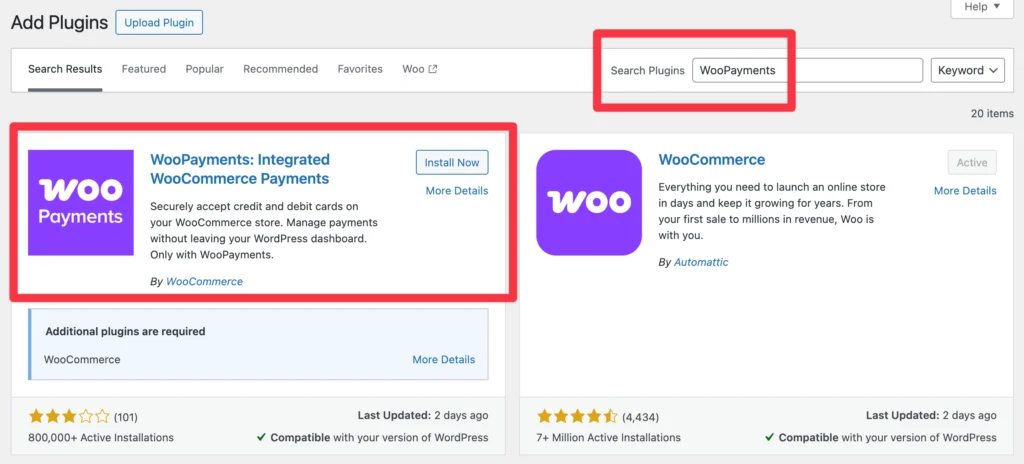
Because WordPress already powered a huge share of the internet’s websites, WooCommerce had an enormous built-in distribution advantage from day one — small businesses that already had a WordPress site could add a functioning store with a few clicks rather than migrating to an entirely new platform.
In May 2015, WooThemes and WooCommerce were acquired by Automattic, the company behind WordPress.com, Tumblr, and Jetpack, founded by WordPress co-creator Matt Mullenweg.
That acquisition gave WooCommerce access to Automattic’s resources, engineering talent, and deep alignment with the broader WordPress open-source ecosystem, cementing its position as the default ecommerce choice for the WordPress world.
Who Owns Shopify and WooCommerce Today?
The ownership structures behind these two platforms could hardly be more different, and that difference explains much of how each platform operates.
Shopify Inc. is a publicly traded company (NYSE/TSX: SHOP) with no single controlling shareholder in the traditional sense, though founder Tobias Lütke holds a special class of shares that preserves his voting control over the company even with a relatively modest economic stake, a structure Shopify adopted specifically to protect long-term decision-making from short-term investor pressure.
WooCommerce, by contrast, is owned by Automattic, a private company that has never gone public and was most recently valued at approximately $7.5 billion in 2025, with estimated annual recurring revenue of around $710 million across its full portfolio of products, including WordPress.com, Tumblr, Pocket Casts, Jetpack, and WooCommerce itself.
Because WooCommerce is fundamentally open-source software released under the GPL license, it isn’t “owned” in the same proprietary sense as Shopify’s platform — anyone can technically fork or self-host the core WooCommerce code, even though Automattic controls the official plugin, marketplace, and most of the paid extensions that make it commercially viable for real businesses.
Shopify’s FY2025 Financial Performance
Shopify’s FY2025 results underscored just how large the company has become.
Full-year revenue reached $11.6 billion, up 30% year-over-year — an acceleration of 4 percentage points compared to FY2024’s growth rate — while gross merchandise volume (GMV), the total value of sales processed through Shopify-powered stores, hit $378.4 billion, up 29% from the prior year.
Profitability was strong as well, with free cash flow of $2 billion representing a 17% free cash flow margin, and the company generated $1.23 billion in GAAP net income for the year, even though that figure was down 39% from FY2024 due to one-time items in the prior-year comparison.
Reflecting confidence in its financial position, Shopify announced a $2 billion share repurchase program alongside its Q4 and full-year results in February 2026.
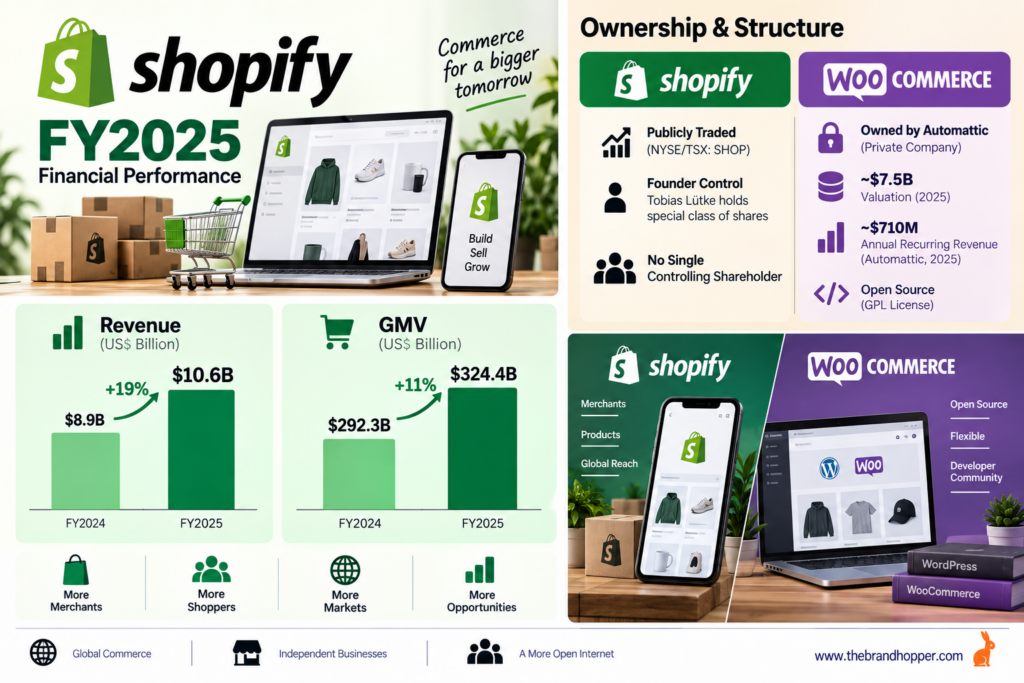
These figures illustrate Shopify’s scale: it isn’t just a small-business tool anymore but a piece of core infrastructure processing hundreds of billions of dollars in commerce annually across everything from solo entrepreneurs to major enterprise brands on Shopify Plus.
WooCommerce’s Market Share and Reach
WooCommerce doesn’t report standalone financials the way Shopify does, since it’s a product line within privately held Automattic rather than an independently reported business.
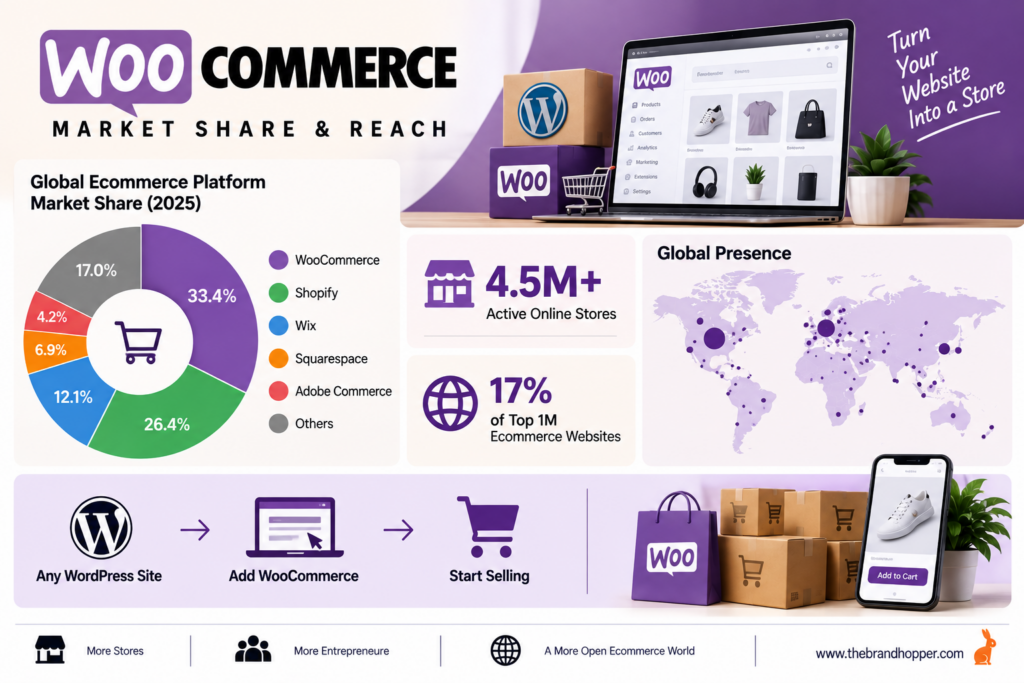
But its footprint by usage is enormous: WooCommerce holds roughly 33.4% average market share of all ecommerce websites globally according to 2025 datasets (with different measurement methodologies putting the range between about 20% and 39%), powers more than 4.5 million active online stores worldwide, and accounts for roughly 17% of the top one million ecommerce websites specifically.
That scale is a direct byproduct of WordPress itself, which continues to power a substantial share of all websites on the internet — any WordPress site can become a WooCommerce store in minutes, giving the plugin a distribution advantage that a standalone platform like Shopify simply cannot replicate.
This also means WooCommerce’s true “market” isn’t limited to Shopify-style ecommerce shoppers; it captures every existing WordPress blog, portfolio, or business site owner who decides to start selling products without switching content management systems entirely.
Pricing: Predictable SaaS Fees vs Pay-As-You-Go Flexibility
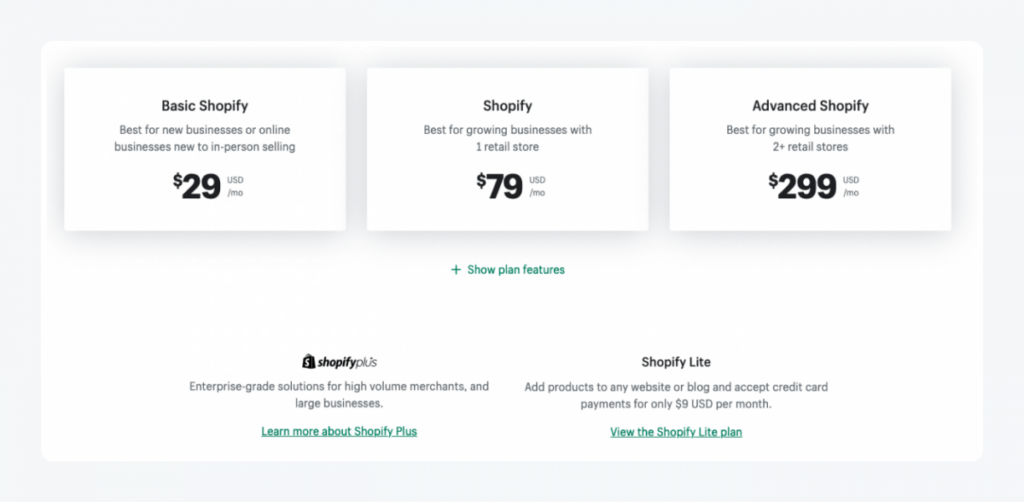
Shopify’s pricing is straightforward and predictable: the core plans are Basic at $39/month, Grow at $105/month, and Advanced at $399/month on monthly billing (with roughly 25% savings available on annual plans, bringing those down to about $29, $79, and $299 respectively), plus payment processing fees ranging from 2.9%+30¢ down to 2.5%+30¢ per transaction depending on plan tier when using Shopify Payments, or an added surcharge of up to 2% if you use a third-party payment gateway instead.
WooCommerce flips this model entirely: the core plugin is completely free to download and use, but store owners must separately pay for web hosting (typically $10-$50+/month depending on traffic and performance needs), a domain name, an SSL certificate, and any premium extensions or themes they want (individual WooCommerce extensions often run $79-$299 per year each for things like advanced shipping, subscriptions, or bookings).
For a very small, low-traffic store, WooCommerce can end up cheaper in raw dollar terms, but as a business scales and adds more extensions, hosting tiers, and developer support, total WooCommerce costs can climb quickly and unpredictably compared to Shopify’s flatter, all-inclusive fee structure.
Ease of Use and Technical Requirements
This is where the two platforms diverge most sharply for a typical small business owner.
Shopify is designed to be usable by someone with zero coding experience: you sign up, pick a theme, add products, connect a payment processor, and you can have a functioning store live within hours, with hosting, security, uptime, and PCI compliance all handled automatically by Shopify’s infrastructure.
WooCommerce requires meaningfully more technical comfort — you (or someone you hire) need to set up WordPress itself, choose and configure a hosting provider, install and configure the WooCommerce plugin plus any needed extensions, manage software updates, and take responsibility for your own site security and backups.
For a solo founder who wants to start selling products this week with minimal fuss, Shopify’s guided setup process is a significant practical advantage; for a business with in-house technical skill (or a willingness to hire a WordPress developer) that wants granular control over every aspect of their site, WooCommerce’s added complexity is the trade-off for that flexibility.
Customization, Ownership, and Flexibility
WooCommerce’s biggest structural advantage is ownership and openness.
Because it’s open-source and self-hosted, store owners have complete access to their underlying code, database, and server environment, meaning there’s no platform-imposed limit on what you can build, no risk of a platform policy change disrupting your business overnight, and full portability of your data at any time.
Shopify, as a closed hosted platform, restricts deeper customization to what its theme templates, Liquid templating language, and app ecosystem allow, and merchants don’t have direct server or database access — a trade-off that most small businesses happily accept in exchange for not having to manage infrastructure themselves, but one that can genuinely frustrate businesses with highly specific technical requirements or those wanting to avoid vendor lock-in over the long term.
App and Extension Ecosystems
Both platforms boast enormous marketplaces of add-ons, though they work differently.
The Shopify App Store contains thousands of apps covering everything from email marketing to inventory management to accounting integrations, almost all designed to work together within Shopify’s managed environment with relatively consistent quality standards and review processes.
WooCommerce’s extension ecosystem is larger in raw numbers thanks to the broader WordPress plugin marketplace, but quality and compatibility can vary more widely since extensions come from a much more fragmented set of third-party developers rather than a single curated app store, occasionally requiring more troubleshooting when multiple plugins interact unexpectedly on the same site.
Which Platform Is Best for You? A Practical Breakdown
If you’re a small business owner with limited technical experience who wants to launch quickly, minimize ongoing maintenance headaches, and pay a predictable monthly fee for a platform that “just works,” Shopify is almost always the safer, faster choice, particularly if you’re starting from scratch with no existing website.
If you already run your business’s content or blog on WordPress, have some technical comfort (or a trusted developer relationship), and prioritize long-term cost control, data ownership, and maximum customization flexibility over convenience, WooCommerce is a genuinely excellent choice that won’t lock you into a single vendor’s ecosystem.
Businesses with very complex, unique technical requirements — deep ERP integrations, unusual product configurators, or highly specific workflow automation — often lean toward WooCommerce’s open-code flexibility, while businesses that value speed-to-launch and dependable customer support tend to gravitate toward Shopify.
Shopify vs WooCommerce at a Glance
| Fact | Shopify | WooCommerce |
| Founded | 2006 (as Shopify), Ottawa, Canada | 2011 (plugin launch) by WooThemes (founded 2008) |
| Founders | Tobias Lütke, Scott Lake, Daniel Weinand | WooThemes team |
| Owner / parent | Shopify Inc. (public, NYSE/TSX: SHOP) | Automattic (private, ~$7.5B valuation) |
| Platform type | Fully hosted, closed SaaS platform | Free, open-source WordPress plugin (self-hosted) |
| FY2025 revenue | $11.6 billion (+30% YoY) | Not separately reported (Automattic ARR ~$710M) |
| Gross merchandise volume | $378.4 billion (FY2025, +29%) | Not publicly disclosed |
| Market share (by site count) | Smaller share, but high sales volume per store | ~33.4% average share of ecommerce websites globally |
| Starting cost | $29-$39/month (Basic plan) | Free plugin + hosting (~$10-$50+/month) |
| Technical skill needed | Low — no-code, guided setup | Moderate-high — hosting, plugins, maintenance |
| Customization | App ecosystem + Liquid templating | Full code, database, and server access |
| Best for | Fast launch, minimal maintenance | WordPress users wanting full control |
Key Takeaways
Shopify and WooCommerce represent two fundamentally different philosophies for small business ecommerce: Shopify is a polished, all-in-one hosted platform backed by a public company that posted $11.6 billion in FY2025 revenue and $378.4 billion in merchant GMV, while WooCommerce is a free, open-source plugin owned by privately held Automattic (valued at roughly $7.5 billion) that remains the world’s most widely used ecommerce solution by site count, powering an estimated third of all online stores.
Shopify wins on ease of setup, predictable pricing, and hands-off infrastructure management, making it the stronger default choice for most small business owners without deep technical resources.
WooCommerce wins on cost flexibility at small scale, data ownership, and unlimited customization for businesses with WordPress experience or in-house technical support.
Neither platform is universally “better” — the right choice depends entirely on your technical comfort level, existing website setup, and how much control you want over your store’s underlying infrastructure.
Frequently Asked Questions
Q: Which is better for beginners, Shopify or WooCommerce?
A: Shopify is generally better for beginners because it’s a fully hosted platform that handles hosting, security, and updates automatically, letting a non-technical small business owner launch a store within hours rather than needing to configure WordPress hosting and plugins themselves.
Q: Is WooCommerce really free?
A: The core WooCommerce plugin is free to download and use, but running a real store requires paying separately for web hosting, a domain name, an SSL certificate, and often premium extensions or themes, so total costs are not zero even though the software license itself is.
Q: Who owns Shopify and WooCommerce?
A: Shopify Inc. is a publicly traded company (NYSE/TSX: SHOP) led by founder and CEO Tobias Lütke. WooCommerce is owned by Automattic, a private company founded by WordPress co-creator Matt Mullenweg, valued at approximately $7.5 billion in 2025.
Q: What was Shopify’s revenue in FY2025?
A: Shopify reported FY2025 revenue of $11.6 billion, up 30% year-over-year, with gross merchandise volume of $378.4 billion and GAAP net income of $1.23 billion.
Q: Which platform has more market share, Shopify or WooCommerce?
A: By site count, WooCommerce leads with roughly 33.4% average market share of ecommerce websites globally, reflecting its integration with the broader WordPress ecosystem, while Shopify leads in total merchant sales volume and enterprise-level adoption.
Q: Is Shopify or WooCommerce cheaper?
A: For very small, low-traffic stores, WooCommerce can be cheaper since the core plugin is free, but costs rise with hosting, extensions, and developer support. Shopify’s flat monthly pricing ($29-$299/month on annual billing) is often more predictable and cost-effective as a store scales.
Q: Can I switch from WooCommerce to Shopify or vice versa?
A: Yes, both platforms support data migration tools and third-party migration services for moving products, customers, and order history, though switching typically requires rebuilding your store’s design and reconfiguring apps or extensions on the new platform.
Q: Do I need coding skills to use WooCommerce?
A: Not strictly, but meaningful technical comfort is helpful. Setting up WordPress hosting, installing WooCommerce and extensions, and maintaining the site over time is more hands-on than Shopify’s fully managed, no-code setup process.
Also Read: Shopify vs BigCommerce: Which Ecom Platform Is Better?
To read more content like this, subscribe to our newsletter