Last Updated on July 7, 2025 by Team TBH
Skyflow is a Silicon Valley startup that pioneered a “data privacy vault” delivered via API. In essence, it provides a secure cloud database for sensitive customer information, accessible through simple API calls. Businesses use Skyflow to isolate and encrypt personal data (PII, payment details, health records) in a zero-trust vault, instead of storing it in their own systems. This allows companies to protect privacy and comply with regulations without rebuilding their entire architecture. By abstracting data security into a service, Skyflow helps prevent costly breaches and lets engineers focus on core product development.
Since its founding in 2019, Skyflow has gained strong traction. It has raised over $100 million in funding and counts industry leaders among its clients. The platform now secures nearly one billion records of personal data and handles about two billion vault API calls per quarter. Customers such as GoodRx (healthcare) and Lenovo (global tech) trust Skyflow to safeguard sensitive data at scale. Skyflow positions itself as critical infrastructure in the age of data and AI, enabling organizations to build trust with users through privacy-by-design.
Founding Story of Skyflow
The idea for Skyflow arose in 2019 from a simple question the founders posed: “What if privacy had an API?”. Anshu Sharma and Roshmik Saha believed companies needed a fundamentally new approach to protect personal data. They saw that many businesses treated privacy as a compliance checkbox and relied on patchwork security tools – meaning once an attacker breached the perimeter, sensitive data was left exposed inside.
The Skyflow founders envisioned instead a dedicated data vault, akin to what Apple did with Apple Pay’s tokenization of card numbers. “Apple Pay doesn’t even ever store or use your real credit card number… Skyflow has taken a similar approach to all the sensitive data,” explains Sharma, allowing companies to perform analytics and machine learning on customer data without exposing actual personal identifiers. Advances in encryption and secure hardware had made this vision feasible by 2019. In mid-2020, Skyflow emerged from stealth with its first product: a privacy API backed by a secure customer data vault.
Founders of Skyflow
Skyflow’s co-founders are Anshu Sharma (CEO) and Roshmik Saha (CTO), both of whom bring deep enterprise software experience. Sharma was previously a Vice President at Salesforce and later a venture partner at Storm Ventures, while Khot served as CTO of AthenaHealth and a Senior VP of Engineering at Salesforce.


Their cloud backgrounds gave them the expertise to architect a secure, scalable data platform. They assembled a team of industry experts in encryption, databases, and security (hailing from Microsoft, Oracle, PayPal, and others) to build Skyflow’s vault service.
The founders’ credibility also drew early support from technology leaders – for example, Okta’s CEO Todd McKinnon commended Sharma and Khot for recognizing that digital trust and privacy would become core to every business.
Business Model of Skyflow
Skyflow operates a business-to-business SaaS model, delivering its Data Privacy Vault as a cloud service. Clients integrate Skyflow via a simple API, offloading the storage and protection of sensitive data to Skyflow’s infrastructure.
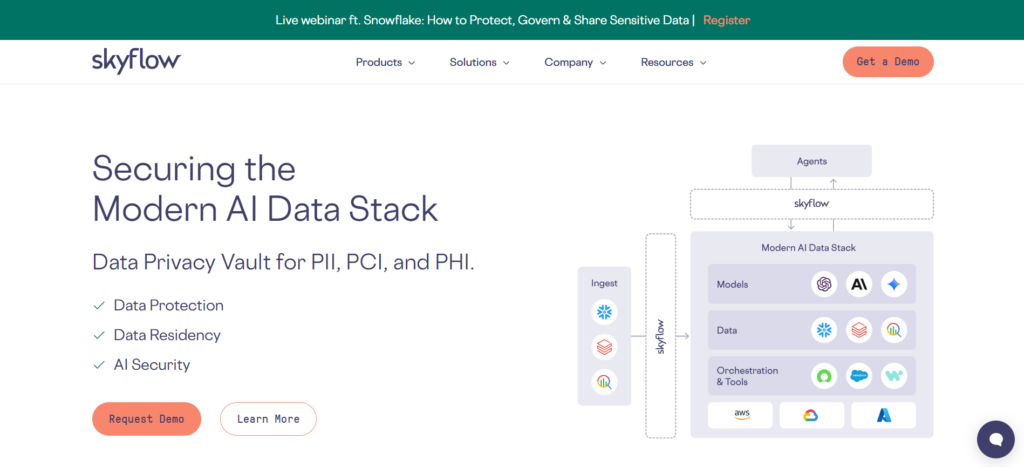
This API-first approach mirrors companies like Stripe or Twilio – Skyflow abstracts away a complex problem (data privacy compliance) behind an easy-to-use interface.
Customers typically pay an annual subscription fee that scales with usage (such as the volume of data or number of records stored). Skyflow emphasizes predictable pricing based on the number of data subjects rather than charging per API call, so companies can use their protected data freely without incurring unpredictable costs.
To accelerate adoption, Skyflow offers vertical-specific vaults tailored to industries with strict regulations. For example, it provides a payments vault for handling credit card data (PCI compliance) and a healthcare vault for patient data (HIPAA compliance).
These pre-configured solutions allow fintechs, banks, hospitals, and other organizations to plug in Skyflow and meet compliance requirements out-of-the-box. Skyflow primarily sells to enterprise and mid-market companies, often via a direct sales process for large deals, while also supporting self-serve signups for developers.
Revenue Streams of Skyflow
Skyflow generates revenue through recurring SaaS fees for its vault platform, typically via annual subscriptions. Given the mission-critical nature of data privacy, contract sizes can be large – the very first customer signed a seven-figure yearly deal within two weeks of launch.
As the client base expanded, Skyflow’s recurring revenue grew rapidly, reportedly achieving 8× growth in a nine-month span in 2021. By early 2024, the company reached a multi–tens-of-millions annual revenue run rate after more than doubling revenue year-over-year.
The platform’s value tends to expand over time within customers, as they add more data and use cases once Skyflow proves its worth. This “land-and-expand” dynamic, coupled with low churn, has underpinned Skyflow’s impressive revenue momentum.
Funding of Skyflow
Skyflow has secured significant venture backing, raising approximately $100 million in total funding across four rounds.
The company’s investors include some of Silicon Valley’s top firms. Foundation Capital led Skyflow’s seed round in 2020, joined by notable angels like former GE CEO Jeff Immelt and Athenahealth co-founder Jonathan Bush.
In late 2020, Canvas Ventures led a $17.5 million Series A with follow-on from Foundation.
Insight Partners headed a $45 million Series B in 2021 (bringing total funding to $70 million), and in 2024 Khosla Ventures anchored a $30 million Series B extension.
This strong funding roster – spanning early-stage specialists to large growth funds – reflects investor confidence in Skyflow’s market potential. The capital has fueled Skyflow’s growth, allowing it to scale its engineering, meet global compliance needs, and form strategic partnerships.
Funding Rounds of Skyflow
The table below summarizes Skyflow’s funding history, including amounts and key investors:
| Date | Round | Amount Raised | Lead Investor(s) |
|---|---|---|---|
| May 2020 | Seed | $7.5 million | Foundation Capital (Ashu Garg); angels Jeff Immelt, Jonathan Bush |
| Dec 2020 | Series A | $17.5 million | Canvas Ventures (Paul Hsiao); (with Foundation Capital) |
| Oct 2021 | Series B | $45 million | Insight Partners (George Mathew); (with Mouro Capital, MS&AD Ventures, Canvas, Foundation) |
| Mar 2024 | Series B Ext | $30 million | Khosla Ventures (Vinod Khosla); (with Canvas, Foundation, Mouro) |
Sources: TechCrunch and company press.
Competitors of Skyflow
Skyflow operates in an increasingly active data privacy technology market. As companies large and small grapple with securing customer data, numerous startups and established firms are offering solutions.
The “data privacy vault” category that Skyflow helped popularize has seen entrants like Very Good Security (VGS) – which provides a similar API-based vault focused on payment data tokenization – and Evervault, an encryption-centric privacy API startup.
In fact, the market for corporate data privacy products is “heating up,” with Skyflow’s Series B in 2021 announced just a day after a competitor, TripleBlind, revealed its own $24 million round.
This illustrates the pace of investment and interest in this space.
Other notable players in the space include data encryption providers like Protegrity and emerging privacy platforms such as OneTrust and Securiti, but these tend to offer point solutions rather than a unified vault. Skyflow’s holistic approach and focus on an easy-to-use API give it a distinct position in the market.
Competitive Advantage of Skyflow
Despite the competition, Skyflow has crafted a strong competitive moat through technology and strategy.
One key advantage is its privacy-by-design architecture. Skyflow’s vault was built with a zero-trust philosophy: data is encrypted (at rest and in transit) using polymorphic encryption, a technique that allows data to be protected in multiple forms yet remain queryable for legitimate uses. This means companies can perform analytics, run machine learning, or share data internally without ever exposing the raw sensitive values.
Traditional encryption solutions often force a trade-off between security and usability, but Skyflow’s approach ensures data remains both protected and usable for business purposes. By solving this technical challenge, Skyflow enables use cases (like personalized analytics on encrypted data) that some competitors cannot easily support.
Another major advantage is developer ease-of-use. Skyflow provides clean APIs and pre-built integrations, making it far easier to adopt than assembling multiple tools. “Skyflow’s approach is radically simple… an API for all your PII data privacy. It’s obvious once you think about it,” said one customer’s CEO in praise of the solution.
By abstracting away the complexity of encryption, tokenization, and compliance into a turnkey service, Skyflow dramatically lowers the implementation effort for clients.
Skyflow also prides itself on comprehensiveness. The vault supports all types of sensitive data (financial, healthcare, etc.) and comes with built-in compliance measures for various laws. It offers regional data residency on-demand, deploying vaults in over 100 countries to meet data localization requirementsbusinesswire.com. Few competitors can match this breadth – Skyflow effectively combines what would otherwise require several point solutions (encryption, tokenization, data masking, audit logging, etc.) into one platform.
Finally, customer results give Skyflow an edge. Real-world testimonials show significant benefits: for example, healthcare platform GoodRx migrated to Skyflow and cut its data security infrastructure costs by over 67% while accelerating deployment timeskyflow.com. Such success stories, along with backing from respected investors, reinforce Skyflow’s credibility. In an era when trust and data protection are paramount, Skyflow’s robust yet easy-to-implement solution provides a tangible competitive advantage for businesses that adopt it.
Conclusion
Skyflow’s brand story is one of innovation at the intersection of data privacy and business needs. In a short span, the company has turned a bold idea (“privacy API”) into a tangible service used by major enterprises. With seasoned founders, enthusiastic investors, and a product that addresses a universal pain point, Skyflow has built a strong foundation for growth. As data protection and AI-driven data use evolve, Skyflow is well positioned to help organizations put privacy first without sacrificing progress. Ultimately, Skyflow stands as an emerging leader defining how sensitive data can be stored and utilized safely at scale.
Also Read: Anthropic – Founders, Business Model, Funding & Competitors
To read more content like this, subscribe to our newsletter