Last Updated on August 10, 2026 by Team TBH
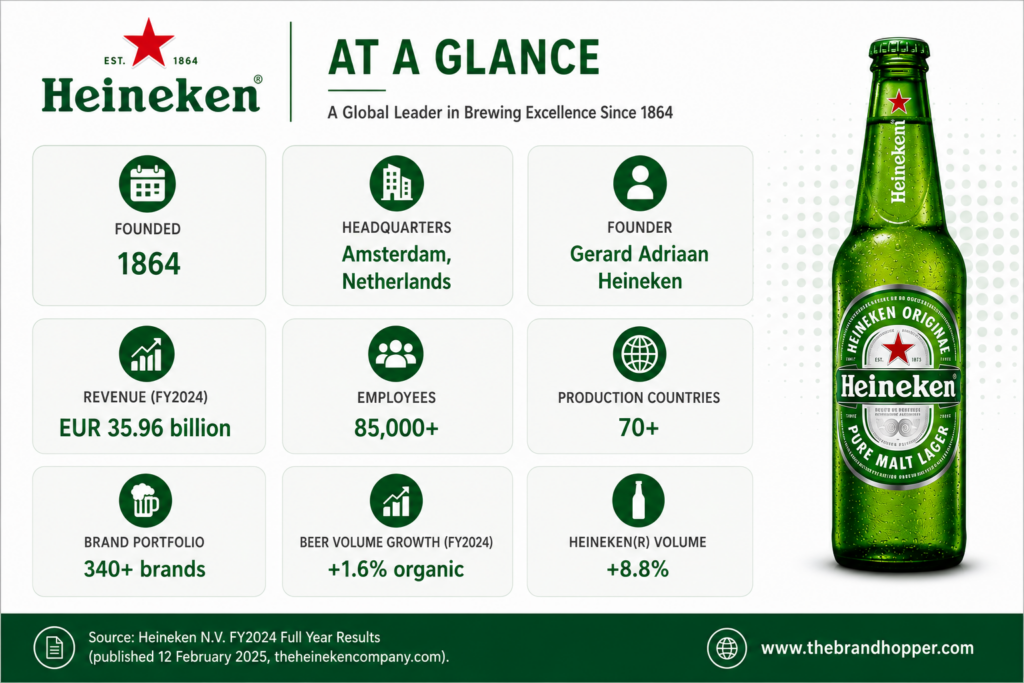
Heineken is one of the most recognisable beer brands in the world — distinguished by its iconic green bottle, red star emblem, and a brewing heritage stretching back to 1864. What began as a single brewery purchase in Amsterdam by a 22-year-old entrepreneur has evolved, across four generations of the Heineken family and more than 160 years of brewing history, into the world’s most international brewer: a EUR 36 billion company with 340+ brands, production facilities in 70+ countries, and a flagship lager that outsells virtually every rival in the premium import category across the globe.
This article traces Heineken’s complete journey — from Gerard Adriaan Heineken’s first brewery purchase, through the marketing genius of Alfred “Freddy” Heineken who built the brand into a global icon, to today’s EverGreen strategy under CEO Dolf van den Brink. It covers the full Heineken drinks portfolio in detail, the company’s global footprint, key acquisitions, financial performance, sustainability commitments, and everything you need to know about one of history’s most enduring beer brands.
1. History and Origins of Heineken
Heineken’s story is one of the great entrepreneurial narratives in business history — spanning four family generations, two world wars, unprecedented global expansion, dramatic personal events, and a consistent thread of brewing innovation that connects the first barrel rolled out of a small Amsterdam brewery in 1864 to the 20+ million hectolitres of Heineken-branded beer sold annually today.
The Founding: De Hooiberg, 1864
On 15 February 1864, Gerard Adriaan Heineken — just 22 years old — purchased a small, struggling brewery called “De Hooiberg” (The Haystack) in the heart of Amsterdam, on the Nieuwezijds Voorburgwal. The brewery had been operating since 1592 and was one of the oldest in the Netherlands, but was failing commercially. Gerard, the son of a prosperous Amsterdam merchant family, had been persuaded by his mother Anna to purchase the brewery rather than join the family trading business. It was a decision that would change the history of beer.
Gerard’s founding vision was simple but radical for the era: produce beer of consistently higher quality than Dutch competitors, using the most modern brewing science available. He invested immediately in new equipment, hired skilled German brewmasters, and adopted bottom-fermentation techniques (lager-style brewing), which were then largely unknown in the Netherlands. Within a decade, the quality improvements were undeniable — and Heineken beer won its first international gold medal at the Paris World Exhibition in 1875.
Expansion and the Founding of Heineken’s Bierbrouwerij Maatschappij (1873)
In 1873, recognising that De Hooiberg was too small to meet growing demand, Gerard Adriaan Heineken purchased a much larger brewery on the Stadhouderskade in Amsterdam — the site that would become the modern foundation of the Heineken brand. The company was formally restructured as Heineken’s Bierbrouwerij Maatschappij NV (Heineken’s Beer Brewing Company). Gerard also established a second brewery in Rotterdam in 1874, rapidly expanding production capacity to serve both domestic and export markets.
The Heineken A-Yeast: A Scientific Breakthrough (1886)
In 1886, Dr. H. Elion — a student of the legendary Louis Pasteur — developed the Heineken A-yeast, a specific strain of bottom-fermenting yeast perfectly suited to Heineken’s brewing process. This yeast, which produces a particularly clean, consistent fermentation at low temperatures, is still the same yeast used to brew Heineken Lager today — more than 130 years later. It is one of the most significant and long-lasting single contributions to any beer brand’s consistency in history. The Heineken A-yeast is proprietary, closely guarded, and is one of the key reasons why Heineken Lager tastes essentially identical whether brewed in Amsterdam, Lagos, Sydney, or São Paulo.
The Company Goes Public (1917) and Enters the USA (1933)
Following Gerard Adriaan Heineken’s death in 1893, his son Henry Pierre Heineken took control of the company in 1914. Under Henry Pierre’s leadership, Heineken listed on the Amsterdam Stock Exchange in 1917, providing capital for further expansion. The most consequential international move came in 1933, when Heineken became the first imported beer to be sold legally in the United States following the end of Prohibition. The company had prepared meticulously: the day after Prohibition ended, Heineken beer arrived in New York harbour. At the Chicago World’s Fair (Century of Progress) in 1933, Heineken won gold medals for brewing quality. These early US wins established the brand as the premium European import and set the foundation for what would become decades of market leadership.
2. The Heineken Family: Four Generations of Brewing Leadership
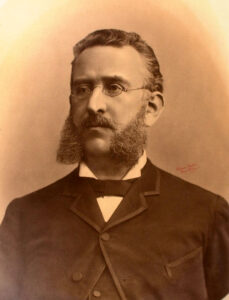
Gerard Adriaan Heineken (1841-1893): The Visionary Founder
Born in Amsterdam on 9 March 1841, Gerard Adriaan Heineken was the driving force behind Heineken’s quality-first philosophy. He believed passionately that Dutch consumers deserved beer as good as the finest German and Bohemian lagers, and he invested accordingly in science, equipment, and talent. His commitment to quality brewing — at a time when adulteration and inconsistency were endemic in the industry — was not only principled but commercially astute. He died in 1893, leaving behind a company that was already nationally recognised and beginning to build an international profile through export success.
Henry Pierre Heineken (1886-1941): International Architect
Henry Pierre Heineken took the company from a national Dutch institution to its first steps as an international enterprise. Taking formal control in 1914, he oversaw the Amsterdam Stock Exchange listing in 1917 and — crucially — positioned Heineken to capitalise immediately on the end of US Prohibition in 1933, which proved to be among the most important commercial decisions in the company’s early international history. Under Henry Pierre, Heineken also survived two World Wars and the Great Depression while maintaining brewing operations and protecting the brand’s quality reputation.
Alfred “Freddy” Heineken (1923-2002): The Brand Architect
Alfred Henry Heineken — universally known as “Freddy” — is the figure most responsible for turning Heineken from a respected Dutch brewer into a global cultural icon. Born on 4 November 1923, Freddy joined the company in 1941 and quickly demonstrated an instinctive genius for marketing and brand building that was exceptional for his era. He became chairman of the executive board in 1971 and held operational leadership until 1989.
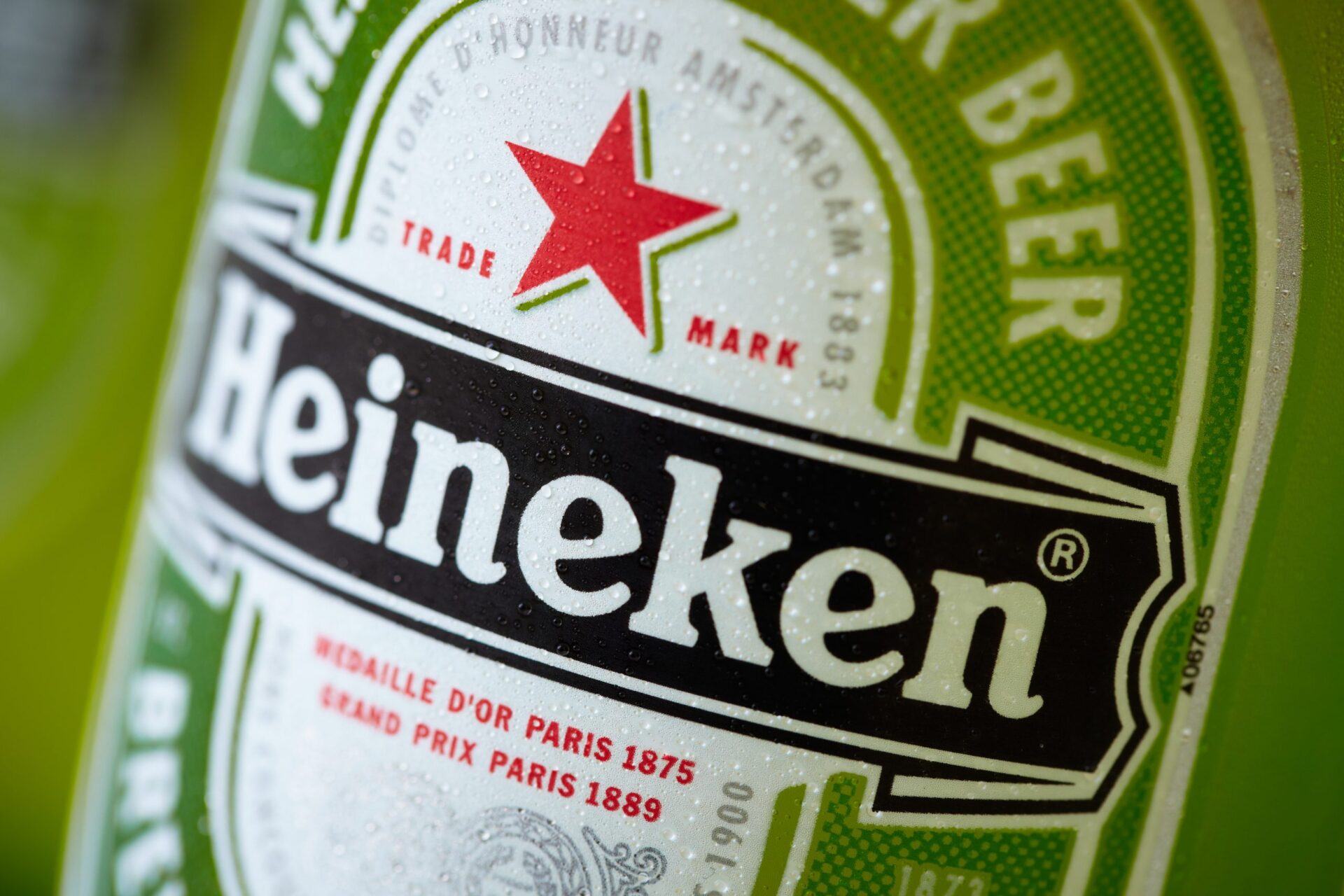
Among Freddy’s most impactful contributions was the design of the distinctive Heineken green bottle and the now-iconic red star, both of which he personally championed to maximise visual recognition in bars, off-licences, and supermarkets globally. He also supervised the creation of the Heineken wordmark with its slightly tilted lowercase “e” — a modification intended to make the letter appear to be smiling, giving the brand a subtle warmth and approachability that was unusual in industrial branding of the 1950s and 1960s.
Under Freddy’s commercial vision, Heineken became the number one imported beer in the United States — a position it held for many years until Corona surpassed it in 1998. He championed the acquisition of the Amstel brewery in 1968, adding Holland’s second largest brewer and gaining a foothold in multiple international markets simultaneously. In 1983, Freddy Heineken and his chauffeur were kidnapped and held for 21 days before being released following the payment of a ransom estimated at approximately 30 million Dutch guilders. The kidnapping became one of the most high-profile corporate abductions in European history and was later the subject of the 2015 film “Kidnapping Mr. Heineken.” Freddy Heineken died on 3 January 2002, leaving an estate and a brand legacy of extraordinary commercial value.
The Modern Era: From Jean-François van Boxmeer to Dolf van den Brink
Following Alfred Heineken’s stepping down from operational leadership in 1989, the company entered a period of professional management while remaining majority-controlled by the Heineken family through Heineken Holding N.V. Jean-François van Boxmeer served as CEO from 2005 to 2020, overseeing transformative acquisitions including FEMSA Cerveza (Mexico, 2010) and Asia Pacific Breweries (Singapore, 2012). Dolf van den Brink became Chairman and CEO in 2020, launching the EverGreen strategic framework in 2021 — the most comprehensive strategic reset in the company’s modern history.
3. Key Milestones in Heineken’s 160-Year Journey
| Year | Milestone |
| 1864 | Gerard Adriaan Heineken purchases De Hooiberg brewery in Amsterdam (est. 1592) |
| 1873 | Heineken’s Bierbrouwerij Maatschappij NV formally established; new brewery on Stadhouderskade |
| 1875 | First international gold medal at the Paris World Exhibition |
| 1886 | Dr. H. Elion develops the proprietary Heineken A-yeast (still used today) |
| 1889 | Wins Grand Prix at the Paris World Exhibition — global brewing recognition |
| 1914 | Henry Pierre Heineken takes control of the company |
| 1917 | Heineken lists on Amsterdam Stock Exchange; Rotterdam brewery begins exports |
| 1929 | First Heineken beer exported outside Europe; Asia and Africa entry begins |
| 1933 | First imported beer sold legally in the USA after Prohibition ends; wins at Chicago World’s Fair |
| 1941 | Alfred “Freddy” Heineken joins the company |
| 1968 | Heineken acquires Amstel brewery — Holland’s second largest (founded 1870) |
| 1971 | Alfred Heineken becomes Chairman; Heineken is already #1 US imported beer |
| 1983 | Alfred Heineken kidnapped; held 21 days before release |
| 1989 | Alfred Heineken steps down from operational leadership |
| 1993 | Heineken celebrates 130 years; opens the Heineken Experience museum in Amsterdam |
| 1998 | Corona surpasses Heineken as #1 imported beer in USA |
| 2002 | Alfred “Freddy” Heineken dies, aged 78 |
| 2010 | Acquires FEMSA Cerveza (Mexico) — adding Dos Equis, Tecate, Sol, Carta Blanca |
| 2012 | Acquires 100% of Asia Pacific Breweries (APB) — Tiger Beer, Anchor, ABC Stout |
| 2017 | Heineken 0.0 launches globally — enters non-alcoholic beer category |
| 2020 | Heineken Silver launches; Dolf van den Brink becomes CEO |
| 2021 | EverGreen strategy launched; exits Russia following Ukraine invasion (completed 2023) |
| 2023 | Completes acquisition of Distell Group (South Africa) — Savanna, Windhoek, Bernini |
| 2024 | Revenue EUR 35.96bn; Heineken(R) volume +8.8%; EUR 1.5bn share buyback announced |
4. The Heineken Brewing Process: A Legacy of Scientific Precision
Heineken Lager’s global consistency — the fact that a glass served in a bar in Amsterdam tastes essentially identical to one served in Lagos, Sydney, or São Paulo — is not accidental. It is the product of an obsessive, scientifically rigorous brewing process that has evolved over 160 years but remains anchored in two foundational elements: the proprietary Heineken A-yeast developed in 1886 and a brewing recipe that has remained largely unchanged since the early 20th century.
Ingredients
Heineken Lager is brewed from four core ingredients: pure water, malted barley, hops, and the proprietary Heineken A-yeast. The malted barley is sourced from select agricultural regions globally and milled to a precise specification before mashing. The hops — which provide Heineken’s characteristic mild bitterness and subtle floral aroma — are sourced from several growing regions including Germany, the Czech Republic, and the United States. Water is adjusted to a specific mineral profile at each Heineken brewery to ensure consistency.
The Brewing Stages
The brewing process at Heineken follows a carefully standardised sequence: mashing (mixing ground malt with hot water to convert starches to sugars, producing “wort”), boiling (the wort is boiled with hops for bitterness and aroma), cooling and fermentation (wort is cooled and the Heineken A-yeast added, fermenting at low temperatures for approximately 10 days to convert sugars to alcohol and CO2), lagering (the “green beer” is stored at near-freezing temperatures for a minimum of 28 days — a longer conditioning period than most mass-market lagers — which smooths the flavour profile and develops the characteristic clean finish), filtration and packaging (the beer is filtered, pasteurised or sterile-filtered, and packaged in Heineken’s distinctive green bottle, keg, or can). The A-yeast itself is carefully maintained and transported to each Heineken brewery globally from the company’s yeast laboratories, ensuring global flavour consistency.
5. Heineken’s Full Drinks Portfolio
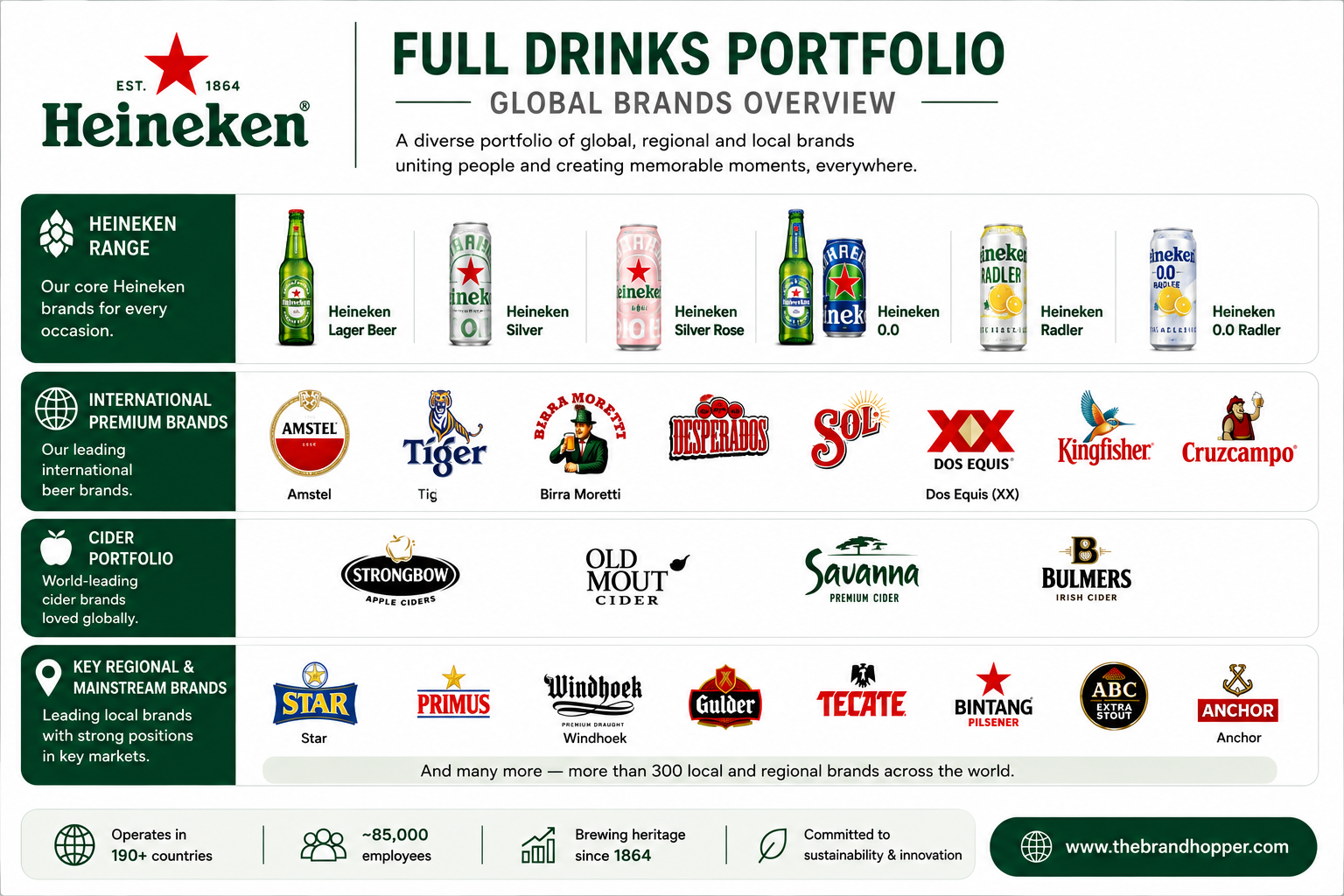
Heineken N.V. manages one of the most diverse beer and cider portfolios in the world — more than 340 brands ranging from the global Heineken flagship to local and regional craft-style beers across every inhabited continent. The portfolio is organised across four strategic tiers: the Heineken masterbrand (global premium), international premium brands, mainstream brands (leading local and regional beers), and the growing low- and no-alcohol category.
The Heineken Masterbrand Range
1. Heineken Lager Beer | 5.0% ABV
The flagship product. A pale lager brewed since 1873 with malted barley, hops, water, and the proprietary A-yeast. Crisp, clean, and moderately bitter with a distinctive hop character and a clean dry finish. Available on draught, in the iconic green bottle, and in aluminium cans. Sold in 190+ countries globally.
2. Heineken Silver | 4.0% ABV
Launched in 2020 as a lighter, smoother alternative to Heineken Lager with fewer calories. Brewed using a cold-filtered process that produces a milder bitterness and a particularly clean, refreshing taste. Targeted at consumers seeking a premium lower-strength option without sacrificing quality. One of Heineken’s fastest-growing products globally.
3. Heineken Silver Rose | 4.0% ABV
A light, rose-tinted lager launched in 2022, blending Heineken Silver’s smooth profile with a subtle fruity character and a distinctive pale pink colour. Positioned as a stylish, occasion-specific beer for social and outdoor drinking moments. Available in key European and Asian markets.
4. Heineken 0.0 | Less than 0.03% ABV
Launched globally in 2017, Heineken 0.0 is Heineken’s category-leading non-alcoholic beer. Brewed using Heineken’s proprietary A-yeast and full brewing process before alcohol is removed via a gentle dealcoholisation technique, then blended for a natural beer taste. In FY2024, Heineken 0.0 grew 10% globally, reinforcing Heineken’s leadership in the fast-expanding no- and low-alcohol category. Available in bottle and can formats globally.
5. Heineken Radler | 2.0% ABV
A refreshing blend of Heineken Lager and natural lemon juice. The Radler (German for “cyclist”) format is traditionally associated with refreshment after outdoor activity. Heineken’s Radler offers a sweet-tart citrus profile with lower alcohol — ideal for afternoon and outdoor occasions. Available in multiple variants across European markets.
6. Heineken 0.0 Radler | Less than 0.05% ABV
The non-alcoholic version of Heineken Radler, combining Heineken 0.0 with natural lemon juice for a completely alcohol-free refreshment option. Part of the growing 0.0 range that Heineken is expanding globally to meet the rising demand for mindful drinking options.
International Premium Brands
Beyond the Heineken masterbrand, the company owns and operates a portfolio of premium international brands that command leading positions in their home markets and significant presence internationally.
1. Amstel | Since 1870
One of Heineken’s most important international brands. Originally founded in Amsterdam in 1870 and acquired by Heineken in 1968, Amstel is a mainstream lager (4.1% ABV) with a particularly strong position in the Netherlands, Greece, Portugal, Brazil, and the UK. Amstel was cited in the FY2024 results as a volume growth driver in Brazil. Available in regular, light, and non-alcoholic variants.
2. Tiger Beer | Since 1932 (acquired by Heineken 2012)
Singapore’s iconic lager, brewed since 1932 and now distributed globally. Acquired by Heineken through its purchase of Asia Pacific Breweries (APB) in 2012. Tiger (5.0% ABV) is the leading premium beer brand across Southeast Asia and has a strong international following, particularly in the UK and Australia. Known for its clean, crisp taste and distinctive orange-gold label.
3. Birra Moretti | Since 1859
An authentic Italian lager with heritage dating to 1859. Birra Moretti (4.6% ABV) is characterised by its premium Italian positioning, the distinctive mustachioed man on the label, and a malt-forward, slightly bitter taste profile. It has become Heineken’s key vehicle for premium growth in the UK market and is widely available across Europe and North America.
4. Desperados | 5.9% ABV
A tequila-flavoured beer originally developed in France and now distributed globally by Heineken. Desperados has a distinctive sweet, fruity character with the subtle warmth of tequila flavouring — appealing strongly to younger adult consumers in nightclub, bar, and festival environments. The FY2024 results cited Desperados as the leading growth driver in the “beyond beer” segment globally.
5. Sol | Since 1899 (Mexico)
A Mexican lager originally brewed in 1899 and now part of Heineken’s international portfolio via the FEMSA Cerveza acquisition (2010). Sol (4.5% ABV) is positioned as a light, refreshing beach-style lager, typically served with a slice of lime. Popular across Latin America, the UK, and increasingly in Asia.
6. Dos Equis (XX) | Since 1897 (Mexico)
One of Mexico’s oldest beers, brewed since 1897 and available in Lager (4.2% ABV) and Amber Ale (4.7% ABV) variants. Acquired via FEMSA Cerveza (2010), Dos Equis is Heineken’s key premium Mexican brand in the North American market and is widely known for its “The Most Interesting Man in the World” advertising campaign.
7. Kingfisher | Since 1857 (India)
India’s best-selling beer, with a market share of approximately 36% of the organised beer market. While Heineken holds a significant stake in United Breweries (the parent of Kingfisher) rather than full ownership, Kingfisher beer benefits from technical support and distribution scale under the Heineken partnership. Kingfisher was cited as a mainstream volume growth driver in the FY2024 results.
8. Cruzcampo | Since 1904 (Spain)
Spain’s leading lager brand, brewed in Seville since 1904. Cruzcampo was acquired by Heineken in 2000 and is one of the best-selling beers in Spain by volume. In FY2024, Cruzcampo was specifically cited by Heineken CEO Dolf van den Brink as a mainstream growth driver in the UK market (where it has been positioned as a premium Spanish lager).
Cider Portfolio
Heineken is also the world’s leading cider producer through its portfolio of international cider brands, led by Strongbow.
1. Strongbow | 4.5% ABV
The world’s best-selling cider brand, produced in the UK since 1960. Strongbow is available in Original, Gold Apple, Dark Fruit, and Rosé variants across more than 40 markets globally. Acquired by Heineken through its purchase of Scottish & Newcastle in 2008, Strongbow commands market leadership in the UK, Ireland, and Australia, and is growing rapidly in Asia-Pacific.
2. Old Mout | 4.0% ABV
A New Zealand-origin fruit cider brand, acquired by Heineken through Scottish & Newcastle. Old Mout (meaning “old mouth” in Maori) offers premium fruit variants including Kiwi & Lime, Berries & Cherries, Pineapple & Raspberry, and Watermelon & Lime. It is positioned as an environmentally conscious premium cider with a playful brand identity.
3. Savanna Cider | 6.0% ABV
South Africa’s iconic dry cider, one of the most loved alcoholic beverages in Southern Africa. Acquired through Heineken’s purchase of Distell Group (completed 2023), Savanna was cited in the FY2024 results as a key “beyond beer” growth driver in Southern Africa. Known for its dry, refreshing taste and distinctive advertising (“It’s dry, but you can drink it”).
4. Bulmers | 4.5% ABV
Ireland’s most popular cider brand. Bulmers (known as Magners outside of the Republic of Ireland) is produced in Clonmel, County Tipperary, and is made from a blend of 17 heritage apple varieties. It played a pivotal role in creating the modern “over ice” cider trend, particularly in the UK, where it is sold as Magners Irish Cider.
Key Regional and Mainstream Brands
The breadth of Heineken’s portfolio extends far beyond its internationally known brands. The company operates as the leading or major brewer in dozens of individual markets, with leading local brands that are household names in their home countries. Notable examples include: Star (Nigeria’s best-selling beer brand, since 1949), Primus (leading beer in the Democratic Republic of Congo and Rwanda), Windhoek (Namibia’s premium beer, part of the Distell acquisition), Legend Extra Stout (Nigeria), Gulder (Nigeria), Tecate (Mexico’s #1 beer brand by volume), Bohemia (premium Czech-style beer in Mexico and Brazil), Anchor (Singapore and Southeast Asia), ABC Extra Stout (Singapore), and Bintang (Indonesia’s leading beer). This regional depth — more than 300 local brands — is one of Heineken’s most significant strategic advantages and a key differentiator from competitors.
6. Heineken’s Global Presence
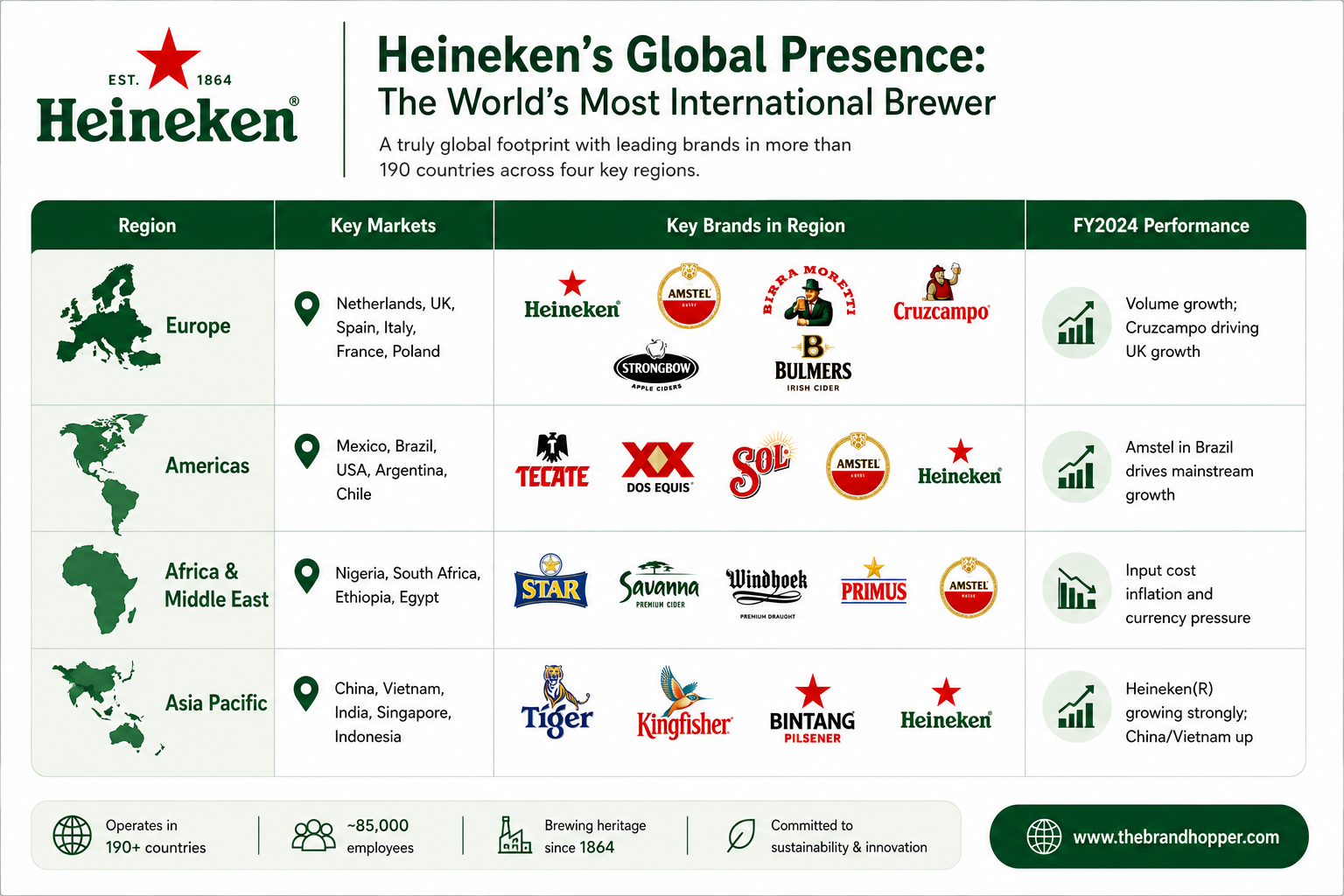
Heineken operates breweries, malteries, cider plants, and other production facilities in more than 70 countries — more than any other brewing company in the world. This geographic footprint, built across 160 years through a combination of organic growth, strategic acquisitions, and joint ventures, is one of Heineken’s most durable competitive advantages. The company is the market leader or a major market player in the majority of its operating markets.
7. Heineken Financial Performance
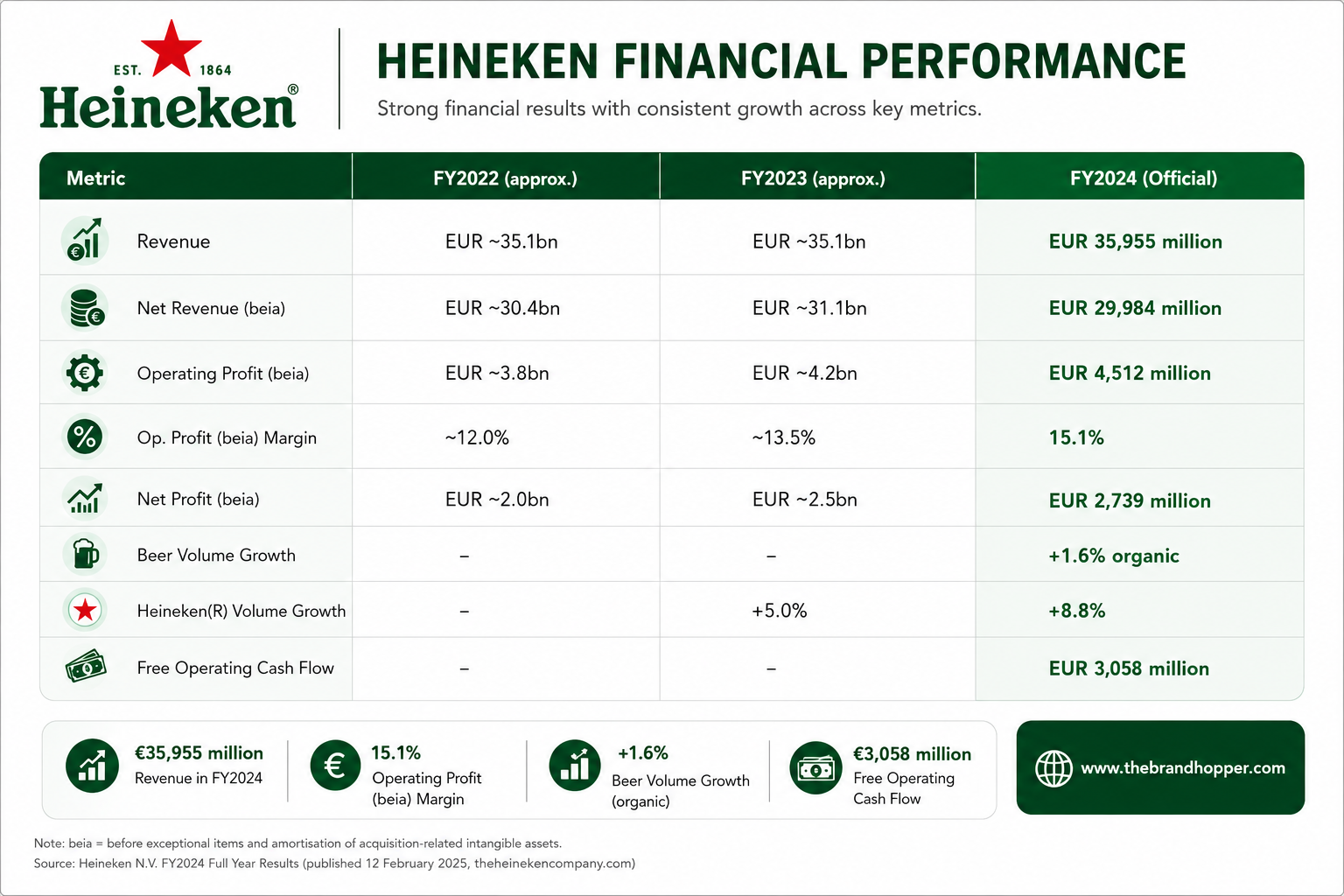
Heineken N.V. is listed on Euronext Amsterdam (ticker: HEIA) and traded OTC in the United States (OTCQX: HEINY). As a publicly listed company, it reports full financial results on a semi-annual basis. The following data is sourced directly from Heineken’s official full-year results announcements.
FY2024 Highlights
Heineken delivered solid FY2024 results against a challenging macroeconomic backdrop. Key highlights include: beer volume growing organically by 1.6% with Heineken-branded volume specifically up 8.8% across 53 markets; net revenue (beia) organic growth of 5.0% (with per-hectolitre growth of 3.5%); premium volume growth of 5%, led by the Heineken brand; mainstream beer growth of 2%, driven by Amstel in Brazil, Cruzcampo in the UK, and Kingfisher in India; beyond-beer segment growth of 4%, led by Desperados and Savanna cider; and Heineken 0.0 volume growth of 10%, reinforcing global leadership in the non-alcoholic beer category. The company launched a EUR 1.5 billion two-year share buyback programme and guided for 4-8% operating profit (beia) organic growth in FY2025.
8. The EverGreen Strategy: Heineken’s Path to Sustainable Growth
Launched in 2021 by CEO Dolf van den Brink, EverGreen is Heineken’s comprehensive strategic framework aimed at achieving “superior and balanced growth” — meaning volume and value growth in balanced proportions, funded by continuous productivity improvements. The strategy reflects lessons learned from the COVID-19 period (which exposed over-dependence on the on-trade hospitality channel) and from years of underinvestment in brands and digital capabilities.
EverGreen is built on three strategic pillars: Portfolio Excellence (building a brand and product portfolio that consumers genuinely desire — shifting mix towards premium, international, and low/no-alcohol); Customer and Consumer Winning (investing more in marketing and selling than any period in the company’s history, with marketing and selling investment increasing by EUR 0.3 billion in FY2024 alone, a double-digit organic increase); and Digital and Technology Transformation (accelerating investment in digital capabilities across e-commerce, data analytics, and supply chain optimisation). The EverGreen strategy has been credited with driving the operating margin (beia) expansion from below 12% in 2021 to 15.1% in FY2024.
9. Brew a Better World: Heineken’s Sustainability Commitments
“Brew a Better World” is Heineken’s global sustainability and responsibility framework, embedding environmental, social, and responsible drinking commitments into the core of its business strategy. Heineken has described sustainability as “not an add-on to our business, but part of our business.”
Environmental Commitments
Heineken has committed to being carbon neutral in production by 2030 and net zero across its full value chain by 2040. In FY2024, the company exceeded EUR 0.6 billion in gross productivity savings, partially funding sustainability investments. Key environmental milestones include: 50% of electricity from renewable sources (already achieved across 33 markets), a commitment to reduce absolute CO2 emissions in production by 30% by 2030 (versus a 2018 baseline), and water efficiency targets targeting a 30% reduction in water usage per hectolitre of beer produced. Heineken also works with thousands of smallholder farmers to promote sustainable barley and hop growing through its Farming for the Future programme.
Responsible Drinking
Heineken has been one of the most active large brewers in promoting responsible drinking and low/no-alcohol alternatives. The Heineken 0.0 range — which grew 10% in FY2024 — is central to this strategy, offering consumers a genuinely satisfying alcohol-free option. Heineken also adheres to a strict Responsible Marketing Code across all markets, operates the “When You Drive, Never Drink” road safety campaign in multiple markets, and participates in alcohol harm reduction programmes globally.
10. Heineken’s Marketing Legacy: From Print Ads to Global Campaigns
Heineken has built one of the most consistent and acclaimed marketing legacies in the consumer goods industry. Key elements of its marketing heritage and current approach include:
The Green Bottle and Red Star: Visual Identity by Design
The Heineken green bottle was not accidental — it was a deliberate strategic choice championed by Alfred “Freddy” Heineken in the 1940s and 1950s to create maximum visibility and differentiation on bar tops and retail shelves dominated by brown bottles. The red star, incorporated into the label since the late 19th century (a symbol used in the brewing industry historically to represent quality), was elevated by Freddy into a powerful and distinctive brand mark. The slightly tilted “e” in the Heineken wordmark — also attributed to Freddy — was designed to suggest a smile, giving the brand a warmth that has been remarkably consistent across decades of design evolution.
Iconic Advertising and Campaigns
Heineken’s advertising has consistently won creative awards and cultural recognition. The brand has long been associated with clever, often humorous advertising that connects beer-drinking moments to male social bonding and adventure — evolving significantly in recent years to be more inclusive and gender-balanced. The “Worlds Apart” campaign (2017), which brought together strangers with opposing world views over a shared beer, was one of the most shared and discussed beer advertisements of the decade. The “Open Your World” platform, “Cheers to All,” and the James Bond partnership (Heineken has been the official beer partner of the Bond franchise since 1997) represent the brand’s consistent positioning around sophistication, openness, and social connection. For a complete view of Heineken’s campaigns, see: heineken.com/global/en/campaigns for the full campaign library.
Sports and Cultural Sponsorship
Heineken is one of the world’s largest sports and cultural sponsors, with major partnerships including UEFA Champions League (primary beer sponsor since 1994), Formula 1 (global beer partner since 2016), Rugby World Cup, and various national and regional sports leagues. These partnerships give Heineken incomparable exposure during some of the world’s highest-rated global broadcast events, reaching hundreds of millions of consumers simultaneously.
11. SWOT Analysis: Heineken’s Strategic Position
| Strengths
● World’s most international brewer — 70+ countries, 340+ brands ● Proprietary Heineken A-yeast (unchanged since 1886) ensuring global consistency ● Iconic visual identity: green bottle, red star (decades of investment) ● Diversified portfolio: premium, mainstream, cider, and no/low alcohol ● UEFA Champions League and Formula 1 sponsorships for global brand reach ● EverGreen strategy delivering operating margin expansion ● Heineken 0.0: global leadership in fast-growing non-alcoholic category |
Weaknesses
● Premium price positioning can limit volume in high-inflation markets ● Limited exposure to super-premium and craft beer segments vs. AB InBev ● Revenue declined in absolute terms in FY2024 (-1.2% total) ● Africa & Middle East profitability challenged by currency and input costs ● Loss of Russia market (formerly a significant revenue contributor) ● Complexity of managing 340+ brands creates portfolio management risk |
| Opportunities
● Non-alcoholic and low-alcohol category growing 8-10% annually globally ● Premiumisation trend in Asia Pacific, India, Africa driving value growth ● Digital direct-to-consumer channels and e-commerce expansion ● Growing health-conscious consumer base favouring mindful drinking choices ● Distell acquisition (2023) opens significant African growth opportunity ● Women and Gen Z consumers increasingly engaging with beer category |
Threats
● AB InBev (Budweiser, Corona, Stella) with larger global scale ● Craft beer movement eroding mainstream volume in developed markets ● Regulatory pressure on alcohol advertising and sponsorship globally ● Currency devaluations in key developing markets (Nigeria, Egypt, Ethiopia) ● Rising raw material and energy costs compressing margins ● Geopolitical instability affecting production and distribution in key markets |
12. Frequently Asked Questions (FAQs) About Heineken
Q: When and where was Heineken founded?
A: Heineken was founded on 15 February 1864 in Amsterdam, Netherlands, when 22-year-old Gerard Adriaan Heineken purchased the De Hooiberg (The Haystack) brewery — an establishment dating back to 1592. The company was formally incorporated as Heineken’s Bierbrouwerij Maatschappij NV in 1873.
Q: How many brands does Heineken own?
A: Heineken N.V. has a portfolio of more than 340 international, regional, local, and specialty beer and cider brands. These range from the global Heineken masterbrand and major international brands (Amstel, Tiger, Birra Moretti, Desperados) to leading local brands in individual markets such as Kingfisher (India), Star (Nigeria), Bintang (Indonesia), Windhoek (Namibia), and Tecate (Mexico).
Q: How many countries is Heineken available in?
A: Heineken beer is available in more than 190 countries. The company operates breweries, malteries, and other production facilities in more than 70 countries, making Heineken the world’s most geographically distributed brewer. Heineken employs more than 85,000 people globally.
Q: What makes Heineken taste the same everywhere in the world?
A: The global consistency of Heineken Lager is achieved primarily through the proprietary Heineken A-yeast, developed in 1886 by Dr. H. Elion and unchanged since then. This yeast strain is maintained in Heineken’s centralised yeast laboratories and distributed to all Heineken breweries globally. Combined with a precisely standardised recipe, ingredient specifications, and rigorous quality control protocols, the A-yeast ensures that Heineken Lager tastes essentially identical whether brewed in Amsterdam, Lagos, or Shanghai.
Q: What is Heineken 0.0 and how is it made?
A: Heineken 0.0 is Heineken’s global non-alcoholic beer, launched in 2017. It is brewed using the same Heineken A-yeast and full brewing process as regular Heineken Lager, then alcohol is removed through a gentle vacuum distillation dealcoholisation process. The dealcoholised brew is then blended to achieve a natural beer taste with less than 0.03% ABV. Heineken 0.0 grew 10% in volume terms in FY2024 and is one of the world’s best-selling non-alcoholic beers.
Q: Why is Heineken beer in a green bottle?
A: The Heineken green bottle was championed by Alfred “Freddy” Heineken in the 1940s and 1950s as a deliberate branding strategy. At a time when virtually all beers were sold in brown bottles, the green bottle created immediate visual differentiation on bar tops and retail shelves. It became so strongly associated with Heineken internationally that it is now one of the most recognised packaging shapes in the global consumer goods industry. Brown bottles are technically marginally better at protecting beer from UV light, but Heineken’s green bottle uses a hop extract that is UV-stable, mitigating this risk.
Q: What is the EverGreen strategy?
A: EverGreen is Heineken’s strategic framework launched in 2021 under CEO Dolf van den Brink. It focuses on three pillars: Portfolio Excellence (building a premium and balanced portfolio consumers desire), Customer and Consumer Winning (significantly increasing investment in marketing, selling, and brand building), and Digital and Technology Transformation (improving digital capabilities across the business). EverGreen has underpinned Heineken’s operating margin (beia) expansion from below 12% in 2021 to 15.1% in FY2024.
Q: What is Heineken’s revenue and how has the business performed recently?
A: In FY2024, Heineken N.V. reported revenue of EUR 35,955 million. Net revenue (beia) grew organically by 5.0%, and operating profit (beia) grew 8.3% organically to EUR 4,512 million. Beer volume grew 1.6% organically, with the Heineken brand itself growing 8.8% in volume — its strongest performance in years. Heineken also announced a EUR 1.5 billion two-year share buyback programme and guided for 4-8% operating profit (beia) organic growth in FY2025. These results confirmed a continued recovery from the challenges of COVID-19 and the Russia exit.
13. Conclusion
Heineken’s 160-year journey from a single Amsterdam brewery to the world’s most international brewer is a story of consistent principles executed with generational patience: quality first (the same A-yeast for 130+ years), branding second (the green bottle, the red star, the “smiling e”), and geographic ambition third (70+ countries, 340+ brands, 190+ markets). What Gerard Adriaan Heineken began in 1864 as a quality-focused local brewery, Alfred “Freddy” Heineken transformed into a global cultural icon, and what today’s leadership is evolving — through EverGreen, Heineken 0.0, the Distell acquisition, and continued premiumisation — into a drinks company genuinely fit for the next 160 years.
From the crisp simplicity of Heineken Lager to the complexity of Savanna Cider, from Tiger Beer’s Southeast Asian heritage to Birra Moretti’s Italian authenticity, the portfolio reflects a company that has mastered the art of being both genuinely global and genuinely local simultaneously. That dual capability — building a world-famous premium brand while maintaining deep roots in individual markets — is perhaps Heineken’s greatest and most enduring competitive advantage.
Also Read: Chipotle — The Success Story of Burritos Behemoth
Also Read: Marketing Strategies and Marketing Mix of Heineken
To read more content like this, subscribe to our newsletter