Introduction: The Company That Connects the World
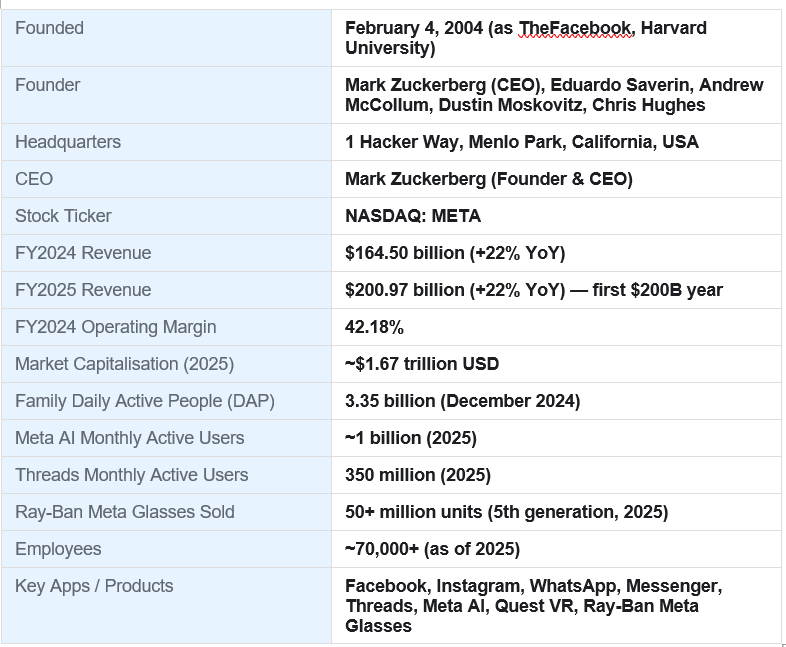
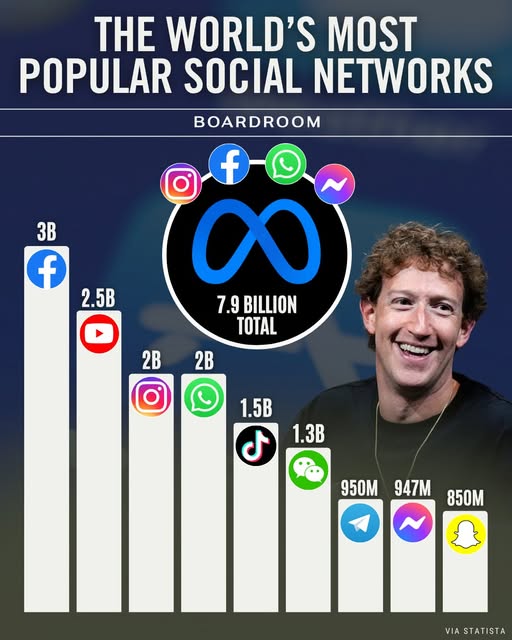
There are very few companies in history that have touched the daily lives of more than three billion people. Meta Platforms is one of them. Every day, approximately 3.35 billion people use at least one of Meta’s applications — Facebook, Instagram, WhatsApp, Messenger, or Threads — to communicate, share, consume content, and conduct business. That is nearly 42% of every person on earth, engaging with a platform Meta owns, every single day.
Meta Platforms, Inc. (NASDAQ: META) is the parent company of this network of applications. In 2025, it crossed $200 billion in annual revenue for the first time — a milestone achieved just 21 years after Mark Zuckerberg launched a college social network from his Harvard dormitory room. With a market capitalisation of approximately $1.67 trillion, Meta is one of the Big Five American technology companies alongside Alphabet, Amazon, Apple, and Microsoft.
But Meta’s story is not simply a story of scale. It is a story of relentless reinvention: from a university network to the global internet’s town square, from desktop to mobile, from social media to advertising platform, from Facebook to Meta, and now from social apps to the frontier of artificial intelligence and augmented reality. Understanding Meta means understanding the forces that have shaped the modern internet — the good, the complicated, and the deeply controversial.
Meta Platforms at a Glance
Founding Story: From Facemash to TheFacebook (2003–2005)
The Harvard Dorm Room (2003–2004)
The genesis of Facebook is one of Silicon Valley’s most retold origin stories — and one of its most contested. In October 2003, a 19-year-old Harvard sophomore named Mark Zuckerberg built Facemash: a website that pulled photos from Harvard’s residential house directories and asked visitors to rate which of two students was more attractive. The site went viral within hours and was shut down by Harvard’s administration within days, but it demonstrated something important: Zuckerberg could build social software that people wanted to use.
Three months later, on February 4, 2004, Zuckerberg launched TheFacebook.com from his Harvard dorm room, along with roommates Eduardo Saverin (who contributed $19,000 in seed funding and became the first CFO), Andrew McCollum, Dustin Moskovitz, and Chris Hughes. The site was initially restricted to Harvard students only. Within 24 hours, 1,200 Harvard students had registered. Within a month, half the Harvard undergraduate population had signed up.
Expansion and First Investment (2004–2006)
TheFacebook expanded rapidly to other Ivy League universities, then to all US universities, and by 2006, to anyone over the age of 13 with a valid email address. The critical early investment came from PayPal co-founder Peter Thiel, who in 2004 provided $500,000 in angel funding in exchange for a 10.2% stake — a bet that would return billions. In 2005, venture capital firm Accel Partners invested $12.7 million, valuing the company at approximately $98 million. Zuckerberg dropped the “The” from the name, bought Facebook.com for $200,000, and relocated the team to Palo Alto, California.
By the end of 2006, Facebook had over 12 million registered users. The News Feed — introduced in September 2006 to widespread user protest that quickly faded as engagement surged — fundamentally changed how people interacted with social media. Instead of visiting individual profiles, users could now see a constantly updating stream of friends’ activities. The architecture of the modern social feed was born.
“Move fast and break things. Unless you are breaking stuff, you are not moving fast enough.” — Mark Zuckerberg, Facebook’s guiding early philosophy, later revised to “Move fast with stable infrastructure.”
The Facebook Era: Explosive Growth & Mobile Pivot (2007–2014)
Platform Opening and Microsoft Investment (2007–2009)
In 2007, Facebook opened its platform to third-party developers through the Facebook Platform API — a decision that sparked an explosion of social games, apps, and integrations that dramatically increased user engagement and time on site. Zynga’s FarmVille, launched in 2009, became so popular it was temporarily responsible for 20% of Facebook’s total web traffic. The same year, Facebook introduced the Like button — one of the most replicated UI elements in internet history, and the foundation of the company’s emotional engagement model.
In October 2007, Microsoft invested $240 million in Facebook for a 1.6% stake, implying a valuation of $15 billion — extraordinary for a company with fewer than 60 million users. This investment validated Facebook’s advertising potential and closed off a possible Microsoft acquisition at a fraction of its later value.
Reaching 1 Billion Users and the IPO (2010–2012)
Facebook crossed 500 million users in 2010 and 1 billion in October 2012 — the first social network to do so. In May 2012, Facebook completed one of the most anticipated IPOs in technology history, raising $16 billion at a valuation of over $100 billion. The IPO was marred by NASDAQ technical glitches, legal complaints about selective disclosure to institutional investors, and a stock price that fell 50% within three months. Sceptics questioned whether Facebook could monetise mobile — at the time of the IPO, the company had essentially no mobile advertising revenue.
The sceptics were wrong. By 2013, Facebook’s stock had recovered and mobile advertising had become its fastest-growing revenue stream. The shift to mobile-first advertising — enabled by the company’s unparalleled identity data and ability to follow users across devices — proved to be one of the most successful strategic pivots in technology company history.
The Acquisitions That Changed Everything (2012–2014)
Two acquisitions in this period defined Meta’s trajectory for the following decade. In April 2012, Facebook acquired Instagram — a 13-person photo-sharing startup with zero revenue — for $1 billion in cash and stock. The deal was widely mocked at the time as grossly overpriced. By 2024, Instagram alone was generating an estimated $66.9 billion in annual advertising revenue, making the $1 billion purchase one of the greatest investment decisions in corporate history.
In February 2014, Facebook announced the acquisition of WhatsApp — the world’s largest messaging app with 450 million users — for $19 billion in cash and stock. The acquisition was the largest venture-backed exit in history at the time and gave Facebook dominance in global mobile messaging, particularly in Europe, India, and Latin America. The same month, Facebook acquired Oculus VR, a virtual reality startup that had raised $2.4 million on Kickstarter, for $2 billion — an early signal of Zuckerberg’s long-term thinking about the future of computing.
Controversies: Data, Influence & Accountability (2016–2021)
From approximately 2016 onward, Facebook’s relationship with the public and regulators fundamentally shifted. The company found itself at the centre of an unprecedented reckoning about the consequences of building the world’s most powerful social network — and optimising it relentlessly for engagement without sufficient regard for what that engagement consisted of.
The Cambridge Analytica Scandal (2018)
In March 2018, investigative reporting revealed that Cambridge Analytica — a political consulting firm connected to the 2016 Trump presidential campaign and the Brexit referendum — had harvested the personal data of up to 87 million Facebook users without their explicit consent. The data was obtained through a quiz app that exploited Facebook’s permissive API to collect not just the quiz-takers’ data, but the data of all their Facebook friends. Zuckerberg was called before the US Senate and House committees in April 2018, leading to five hours of televised testimony. In 2019, the FTC fined Facebook $5 billion — the largest fine ever imposed on a technology company — for its privacy violations.
Misinformation, Election Interference & the Whistleblower
Facebook faced sustained criticism for its role in enabling the spread of election-related misinformation in the United States and elsewhere, and for amplifying divisive, emotionally charged content through its algorithmic ranking systems. In 2021, former Facebook product manager Frances Haugen became one of Silicon Valley’s most consequential whistleblowers, leaking thousands of internal documents — collectively known as the ‘Facebook Papers’ — to regulators and journalists. The documents showed that Facebook’s own research had found Instagram to be harmful to the mental health of teenage girls, and that the company had repeatedly prioritised engagement and revenue over safety.
These controversies accelerated regulatory scrutiny globally. The EU’s Digital Markets Act and Digital Services Act, the UK’s Online Safety Act, and multiple US antitrust investigations all drew directly or indirectly on the accumulating evidence of Facebook’s conduct. Meta has spent billions on content moderation and safety infrastructure in response — but the reputational damage to the Facebook brand among younger users has been lasting.
The Rebrand: Facebook Becomes Meta (October 2021)
On October 28, 2021 — at the height of the Facebook Papers controversy — Mark Zuckerberg announced that the company’s parent entity would be renamed Meta Platforms, Inc. The rebrand was intended to signal a fundamental strategic redirection: Meta would no longer be defined by Facebook, the product. It would be defined by its ambition to build the metaverse — the next generation of social computing, built on virtual and augmented reality.
The timing was cynically noted by critics, who observed that the rebrand came as the company faced the worst reputational crisis in its history. But Zuckerberg insisted the decision had been in development for months. ‘Our brand is so tightly linked to one product,’ he said during the announcement, ‘that it can’t possibly represent everything we’re doing today, let alone in the future. Over time, I hope we are seen as a metaverse company.’
The name Meta comes from the Greek word for ‘beyond’, reflecting the company’s ambition to build experiences beyond the physical world. The company’s new logo — a stylised infinity loop, rendered in gradient blue — replaced the simple lower-case ‘f’ of Facebook as the corporate identity. While the Facebook product retained its name, the parent company’s new identity formally subordinated it to a broader vision.
Meta’s Products & Platforms
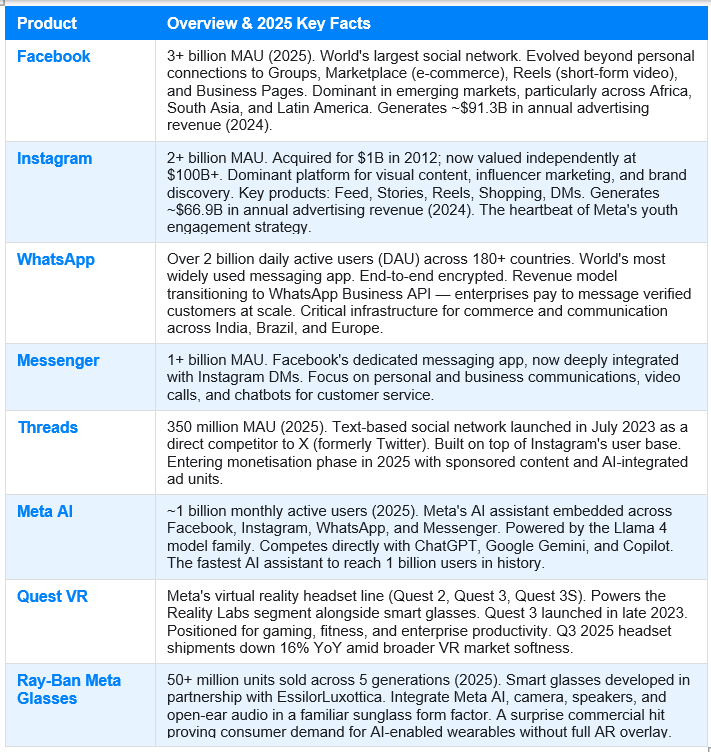
Meta operates the world’s most widely used family of social and communication applications, alongside a growing portfolio of AI and hardware products.
Financial Performance: The $200 Billion Milestone
Meta’s financial performance between 2022 and 2025 is one of the most remarkable turnaround stories in technology company history. In 2022, the company’s stock fell 65% in a single year — its worst performance since listing — as a combination of Apple’s iOS privacy changes (which disrupted Meta’s ad targeting), TikTok’s competitive rise, recession fears, and escalating Reality Labs losses converged simultaneously. Meta responded with its ‘Year of Efficiency’ initiative in 2023: mass layoffs (approximately 21,000 jobs), a restructuring of management layers, and a ruthless focus on engineering productivity.
The results vindicated the strategy decisively. FY2024 revenue reached $164.50 billion — a 22% increase year-on-year — with advertising revenue alone contributing $160 billion. The operating margin expanded to 42.18%, one of the highest in the technology sector. In 2025, Meta crossed $200 billion in annual revenue for the first time, with FY2025 revenue of $200.97 billion (+22% YoY). The Family Daily Active People metric — measuring unique humans who use at least one Meta app daily — reached 3.35 billion in December 2024, growing 5% year-on-year.
The revenue engine is powered by digital advertising. Meta’s ad platform combines unparalleled first-party user data (demographics, interests, social connections, content engagement), AI-driven ad targeting and optimisation, and massive reach across the Family of Apps. In 2024, ad impressions grew 11% year-on-year while the average price per ad increased 10% — a combination of volume and yield improvement that few advertising platforms can sustain simultaneously. Instagram ($66.9B) and Facebook ($91.3B) together account for the vast majority of advertising revenue.
Key Acquisitions: Building the Meta Empire
Meta has made over 100 acquisitions since 2004. Most are small talent acquisitions. The strategic ones have been transformative.
| Year | Company | Price | Strategic Rationale |
| 2012 | $1B | Dominant mobile photo-sharing app. 13 employees, zero revenue. Became Meta’s most valuable asset — generating ~$66.9B in 2024 ad revenue. | |
| 2014 | $19B | World’s largest messaging app (450M users). Locked up global mobile messaging, especially in emerging markets. Remains a cornerstone of Meta’s DAU base. | |
| 2014 | Oculus VR | $2B | Pioneer in consumer VR headsets. Became the foundation of the Reality Labs segment and Meta’s hardware business. |
| 2015 | TheFind | Undisclosed | E-commerce search engine to power Facebook’s shopping and product discovery features. |
| 2016 | Masquerade | Undisclosed | AR face-filter technology to compete with Snapchat’s viral augmented reality features on Instagram and Messenger. |
| 2019 | CTRL-labs | ~$500–$1B | Neurotechnology startup developing non-invasive neural interfaces — wristbands that translate nerve signals into digital commands. Long-term AR/VR input R&D. |
| 2020 | Giphy | ~$400M | GIF library used across social media and messaging. EU and UK regulators later forced Meta to divest it, citing competition concerns. |
| 2020 | Kustomer | ~$1B | CRM platform to power Meta’s business messaging and WhatsApp Business tools. |
| 2022 | Within (Beat Saber parent) | ~$400M | VR fitness and gaming content to strengthen Quest’s content library. FTC attempted to block the deal; courts allowed it to proceed. |
Meta’s AI Strategy: The $70 Billion Open-Source Bet
If the metaverse was Meta’s defining strategic narrative of 2021–2022, artificial intelligence is its defining narrative of 2024–2025. Meta has committed approximately $70 billion to AI infrastructure investment, and the early returns — measured in advertising effectiveness, user engagement, and the explosive growth of Meta AI — suggest this bet is paying off faster than the metaverse pivot did.
The Llama Ecosystem: Open-Source AI Leadership
Meta’s most consequential AI decision has been its open-source strategy through the Llama model family. Where OpenAI (GPT-4), Google (Gemini), and Anthropic (Claude) have kept their frontier models proprietary, Meta releases its Llama models openly — allowing developers, researchers, and businesses to use, fine-tune, and deploy them freely. Llama 4, released in early 2025 with Scout and Maverick variants, has cemented Meta’s position as the leader in open-source large language models.
The strategic logic is compelling: by making Llama freely available, Meta accelerates the development of an AI ecosystem that does not rely on proprietary APIs. This builds goodwill with the developer community, potentially establishes Llama as the default open-source AI infrastructure for the next decade, and differentiates Meta from competitors who charge for AI access. The open-source strategy also provides a competitive counter-narrative to concerns about Meta’s data practices — positioning the company as a contributor to public AI development rather than a gatekeeper of AI capabilities.
Meta AI: A Billion Users in Record Time
Meta AI — the AI assistant embedded across Facebook, Instagram, WhatsApp, and Messenger — reached approximately 1 billion monthly active users in 2025, making it the fastest AI assistant in history to reach that scale. The advantage is distribution: Meta AI is embedded in applications that 3.35 billion people already use daily. When someone opens WhatsApp to message their family, Meta AI is one tap away. No competing AI assistant has access to that kind of embedded, habitual user base.
Meta AI powered by Llama 4 supports real-time multimodal interactions — text, images, voice — and is deeply integrated with Instagram’s visual search, WhatsApp’s business tools, and Facebook’s content discovery. AI-powered ad optimisation has been a particularly significant revenue driver, improving advertiser return on investment and supporting the higher ad pricing that contributed to Meta’s 2024–2025 revenue growth.
Ray-Ban Meta Glasses: The Wearables Renaissance

Meta’s partnership with EssilorLuxottica for Ray-Ban Meta smart glasses has been the surprise hardware success story of 2024–2025. By the 5th generation, cumulative unit sales had surpassed 50 million — extraordinary for a hardware product in its category. The glasses integrate Meta AI, an open-ear speaker system, a camera for capturing and sharing moments, and call functionality, all within a design indistinguishable from standard Ray-Ban sunglasses. The product has proved that consumer AI wearables do not require a full AR overlay to achieve commercial success — they simply need to be functional, fashionable, and affordable.
Reality Labs: The $73 Billion Long Game
Reality Labs — the Meta division responsible for VR headsets (Quest), AR glasses development, and metaverse infrastructure — has accumulated approximately $73 billion in operating losses since Zuckerberg made it a strategic priority in 2019. In Q3 2025 alone, Reality Labs reported an operating loss of $4.43 billion on revenue of just $470 million. These numbers represent one of the most scrutinised capital allocation decisions in modern corporate history.
Zuckerberg’s position remains consistent: the transition from smartphones to spatial computing — glasses and headsets as the next primary computing platform — will take a decade, and the companies that invest now will own the platform layer. The comparison to Amazon’s decade-long investment in AWS before it became profitable is frequently invoked.
The Quest 3 headset, launched in late 2023, was well received critically but has faced softer consumer demand than expected, with shipments down 16% year-on-year in Q3 2025. The metaverse platform Horizon Worlds has not achieved mass adoption. However, Zuckerberg has indicated that AR glasses — likely the consumer heir to the Ray-Ban Meta lineage but with a full transparent overlay display — are on the horizon, and the company believes these will ultimately dwarf smartphone adoption in scale.
For investors, Reality Labs remains a high-conviction, long-duration bet: accept $15–20 billion in annual losses now for the possibility of owning the next computing platform. The bet is funded by the Family of Apps’ extraordinary cash generation — and as long as the advertising business grows at 20%+ per year, Meta can afford to run this experiment.
Competitive Landscape: Meta vs the World
Social Media: TikTok, YouTube, Snapchat, X
In social media, Meta’s most significant competitor for attention — particularly among users under 30 — is TikTok, ByteDance’s short-form video platform with over 1 billion MAU globally. TikTok’s algorithm-driven content discovery model proved so engaging that Meta reverse-engineered it with Reels, available on both Facebook and Instagram. Instagram Reels has successfully arrested the migration of younger users to TikTok in many markets, though TikTok continues to lead among Gen Z. YouTube (Alphabet) competes across video content. X (formerly Twitter, owned by Elon Musk) competes with Threads in real-time public discourse, though Threads’ 350 million MAU significantly exceeds X’s claimed user base.
Digital Advertising: Google/Alphabet
In digital advertising — Meta’s core revenue source — the primary competitor is Alphabet/Google. Together, Meta and Google account for over 50% of global digital advertising revenue. Google leads in search intent advertising (people actively looking to buy); Meta leads in social discovery advertising (reaching people before they know they want something). The two models are complementary but increasingly compete for the same advertiser budgets. Meta’s AI-powered ad optimisation improvements in 2024–2025 have strengthened its competitive position, driving higher ROAS (Return on Ad Spend) for advertisers.
AI: OpenAI, Google DeepMind, Anthropic
In AI, Meta competes for developer mindshare with OpenAI (GPT-4o, o3), Google DeepMind (Gemini), Anthropic (Claude), and others. Meta’s differentiation is its open-source strategy (Llama) and unmatched distribution (1 billion Meta AI users). Meta does not, however, offer AI services commercially in the same way as OpenAI’s API or Google’s Vertex AI platform, which limits its ability to monetise AI directly. The company’s AI revenue is indirect: through advertising optimisation, engagement improvements, and hardware (Ray-Ban glasses).
Challenges, Risks & Regulatory Pressure
Meta faces a set of structural, regulatory, and reputational challenges that represent material risks to its business model.
Antitrust remains the most existential legal threat. The FTC’s lawsuit seeking to force Meta to divest Instagram and WhatsApp — arguing the acquisitions were anti-competitive — has proceeded through the courts and represents a genuine risk that, if successful, would fundamentally restructure the company. Meta’s argument is that the social media market is competitive and that Instagram and WhatsApp have grown because of Meta’s investment, not in spite of competition.
Youth safety and mental health concerns have intensified. Multiple US states and the UK government have sued Meta over claims that Instagram’s algorithmic design is knowingly harmful to children and teenagers. The litigation, combined with mounting legislative pressure for age verification requirements and algorithm transparency, could materially affect how Meta operates its platforms for younger users — a critical demographic for long-term platform health.
Privacy regulation continues to evolve globally. The EU’s GDPR has resulted in multiple significant fines for Meta, including a record €1.2 billion fine in 2023 for transferring EU user data to US servers. Meta’s advertising model is fundamentally dependent on the collection and processing of personal data; increasing restrictions on cross-site tracking (initiated by Apple’s App Tracking Transparency framework) and the ongoing global privacy legislative agenda represent persistent headwinds.
AI hallucination and content quality risks are emerging concerns for Meta AI. As Meta AI handles more of its users’ information and decision-making, the reliability and safety of its responses become brand-critical. A high-profile AI failure at the scale of 1 billion users could damage trust in ways that are difficult to repair.
Future Outlook: Meta’s Path to 2030
Meta enters the second half of the 2020s with genuine momentum and genuine risk in equal measure. The advertising business is growing faster than at any time since 2021, the AI strategy is delivering measurable results, and the hardware business has produced its first mass-market success in Ray-Ban Meta glasses.
The three strategic bets that will define Meta through 2030 are: First, AI monetisation — whether Meta can translate 1 billion Meta AI users into direct revenue through premium subscriptions, business services, or commerce integrations. Second, AR glasses — whether the next generation of Ray-Ban Meta or a successor product with a full AR overlay can achieve the mass-market adoption that would validate the Reality Labs investment thesis. Third, creator and commerce ecosystems — whether Meta can build Instagram and WhatsApp into end-to-end commercial platforms where discovery, engagement, and transaction all happen within Meta’s apps, reducing dependency on Google’s search-to-purchase funnel.
If Meta’s AI bets pay off as comprehensively as its mobile advertising bet did between 2012 and 2015, the company’s current $1.67 trillion valuation may look modest in retrospect. If Reality Labs continues to lose $15–20 billion per year without a breakout hardware product, shareholder pressure to wind down or spin off the division will intensify. The story of Meta in the 2020s is a story still being written — by engineers in Menlo Park, regulators in Brussels and Washington, and the 3.35 billion people who open a Meta app every single day.
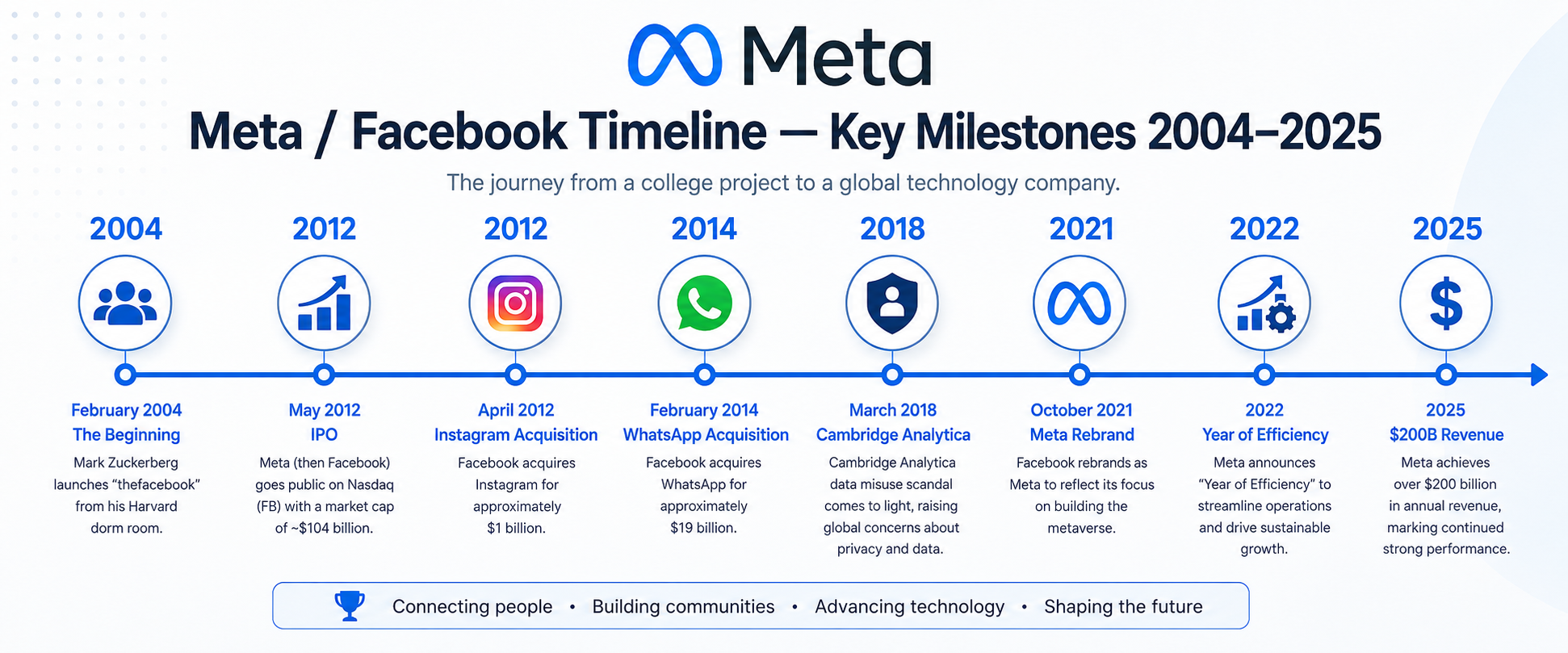
Meta / Facebook: Key Milestones 2004–2025
| 2004 | Mark Zuckerberg launches TheFacebook.com at Harvard. 1,200 sign-ups in first 24 hours |
| 2005 | Expands to all US universities; Peter Thiel invests $500K; domain Facebook.com purchased for $200K |
| 2006 | Opens to public (anyone 13+); News Feed launched; Microsoft invests $240M at $15B valuation |
| 2009 | Like button introduced. Facebook reaches 300M users |
| 2010 | Facebook reaches 500 million users. First ‘social graph’ concept articulated |
| 2012 | IPO at $100B+ valuation; Instagram acquired for $1B; crosses 1 billion users |
| 2014 | WhatsApp acquired for $19B; Oculus VR acquired for $2B; crosses 1.3B MAU |
| 2015 | Facebook reactions (Love, Haha, Wow, Sad, Angry) launched globally |
| 2016 | Facebook Live launched; 1.86B MAU; Cambridge Analytica data collection begins (exposed 2018) |
| 2018 | Cambridge Analytica scandal; Zuckerberg’s Senate testimony; $5B FTC fine; 2.27B MAU |
| 2020 | Revenue $85.9B; COVID drives surge in usage; Giphy acquired; 2.8B MAU |
| 2021 | Rebranded as Meta Platforms (Oct 28); Frances Haugen whistleblower revelations; 2.9B MAU |
| 2022 | Revenue $116.6B (first annual decline since IPO); ‘Year of Efficiency’ announced; 21,000 layoffs begin |
| 2023 | Year of Efficiency delivers record margins; Threads launches and reaches 100M users in 5 days; Llama 2 open-sourced |
| 2024 | Revenue $164.5B (+22%); Meta AI reaches 500M MAU; Ray-Ban glasses 4th gen launched; 3.27B Family DAP |
| 2025 | Revenue $200.97B (first $200B year); Meta AI reaches 1B MAU; Threads reaches 350M MAU; Ray-Ban 5th gen 50M+ units |
Frequently Asked Questions (FAQs)
Q: Why did Facebook change its name to Meta?
A: Facebook renamed its parent company Meta Platforms, Inc. on October 28, 2021. Mark Zuckerberg explained that the name ‘Meta’ (from the Greek for ‘beyond’) better reflected the company’s new strategic direction toward building the ‘metaverse’ — a vision of immersive, interconnected virtual and augmented reality experiences. The rebrand also served to distance the parent company from the reputational challenges associated specifically with the Facebook app, following the Facebook Papers whistleblower revelations. The Facebook, Instagram, WhatsApp, and Messenger apps retained their individual names.
Q: Who founded Meta (Facebook) and who runs it today?
A: Meta was founded on February 4, 2004 by Mark Zuckerberg, Eduardo Saverin, Andrew McCollum, Dustin Moskovitz, and Chris Hughes — all Harvard University students or alumni. Zuckerberg remains CEO and holds voting control of the company through super-voting Class B shares. As of 2025, Meta’s CFO is Susan Li, and its CTO is Andrew Bosworth (who also leads Reality Labs). Mark Zuckerberg retains effective control of the company despite institutional shareholders’ periodic efforts to separate the CEO and chairman roles.
Q: What is Meta’s revenue and how does it make money?
A: Meta’s FY2025 revenue was $200.97 billion — its first year crossing $200 billion. The vast majority (approximately 97–98%) of Meta’s revenue comes from digital advertising. Advertisers pay to reach Meta’s users across Facebook, Instagram, Messenger, and WhatsApp via targeted ad placements. Meta’s advertising advantage lies in its unparalleled first-party user data, which enables advertisers to reach specific audiences with remarkable precision. A small but growing share of revenue comes from Reality Labs hardware (Quest VR headsets, Ray-Ban smart glasses) and business messaging services.
Q: How many people use Meta’s apps daily?
A: Meta’s Family Daily Active People (DAP) metric — the number of unique individuals who use at least one Meta app on a given day — was 3.35 billion in December 2024, representing 5% year-on-year growth. This figure spans Facebook (3B+ MAU), Instagram (2B+ MAU), WhatsApp (2B+ DAU), Messenger (1B+ MAU), and Threads (350M MAU). Meta AI had approximately 1 billion monthly active users by 2025. These numbers make Meta’s apps the most widely used digital products in human history.
Q: What happened with the Cambridge Analytica scandal?
A: In March 2018, it was revealed that Cambridge Analytica — a political consulting firm — had harvested the personal data of approximately 87 million Facebook users without their explicit consent through a quiz application that exploited Facebook’s API. The data was used to build psychological profiles for targeted political advertising during the 2016 US presidential election and the Brexit referendum. Facebook CEO Mark Zuckerberg testified before the US Congress in April 2018. In 2019, the FTC fined Meta $5 billion for privacy violations — the largest fine ever levied on a technology company at the time. The scandal accelerated global data privacy regulation and permanently altered public perception of Facebook.
Q: What is Meta’s metaverse strategy and is it working?
A: Meta’s metaverse strategy, announced with the company’s rebranding in October 2021, envisions spatial computing — VR headsets and AR glasses — as the next major computing platform after smartphones. The strategy is executed through the Reality Labs division. Reality Labs has accumulated approximately $73 billion in cumulative operating losses through 2025, and its Horizon Worlds platform has not achieved mass adoption. However, the Ray-Ban Meta smart glasses — which incorporate Meta AI, a camera, and speakers into a standard sunglass form factor — have sold over 50 million units and represent the first genuine commercial success for the strategy. Zuckerberg has described full AR glasses as a multi-year roadmap item still in development.
Q: What is Meta AI and how does it compare to ChatGPT?
A: Meta AI is an AI assistant powered by Meta’s Llama 4 language model, embedded across Facebook, Instagram, WhatsApp, and Messenger. By 2025, it had approximately 1 billion monthly active users — making it the most widely distributed AI assistant in the world by this metric, ahead of ChatGPT (which has approximately 200 million MAU), Google Gemini, and Microsoft Copilot. Meta AI’s primary advantage is distribution — it lives inside apps that 3.35 billion people use daily. ChatGPT and Claude maintain advantages in raw model capability, enterprise features, and API accessibility. Meta’s Llama models are released as open-source, while OpenAI’s GPT-4 series remains proprietary.
Q: Why did Meta acquire Instagram for $1 billion in 2012?
A: Facebook acquired Instagram in April 2012 for $1 billion in cash and stock when Instagram had 30 million users, 13 employees, and zero revenue. The strategic rationale was twofold: eliminating a potential competitor in mobile social sharing before it could challenge Facebook’s dominance, and acquiring the talent and technology needed to win in mobile photography. The deal was widely criticised at the time as extravagant. In retrospect, it was one of the greatest acquisitions in corporate history — by 2024, Instagram alone generated approximately $66.9 billion in advertising revenue, making it more valuable than entire listed companies.
Q: What is Threads and how is it performing?
A: Threads is Meta’s text-based social network, launched on July 5, 2023 as a direct competitor to X (formerly Twitter). Threads is built on Instagram’s infrastructure and allows Instagram users to sign up immediately using their existing account. Within five days of launch, Threads reached 100 million sign-ups — the fastest app to achieve that milestone in history. As of 2025, Threads has 350 million monthly active users and is entering its monetisation phase with sponsored content and AI-integrated advertising units. Threads competes directly with X, Bluesky, and Mastodon for the real-time public discourse audience.
Q: What are Meta’s biggest risks and challenges?
A: Meta faces five categories of material risk. Regulatory/antitrust: the FTC lawsuit seeking divestiture of Instagram and WhatsApp remains an existential legal threat. Youth safety: multiple governments are legislating age verification and algorithmic transparency requirements that could change how Meta operates for users under 18. Privacy: EU GDPR enforcement (including a €1.2B fine in 2023) and Apple’s iOS tracking restrictions continue to constrain Meta’s ad targeting capabilities. Competition: TikTok remains a formidable rival for younger users and short-form video attention. Reality Labs: the ~$73B in cumulative losses represent significant shareholder value destruction if the AR/VR thesis does not materialise.
Conclusion
Meta Platforms is one of the most extraordinary companies in the history of technology — and one of the most contested. In just over two decades, Mark Zuckerberg transformed a Harvard social experiment into a $1.67 trillion corporation that is simultaneously the world’s largest social media company, one of its largest advertisers, a leading AI developer, a hardware maker, and a long-term bet on the next computing platform.
The journey from Facebook to Meta has not been smooth. The Cambridge Analytica scandal, the Facebook Papers, the 65% stock crash of 2022, and the $73 billion Reality Labs losses have tested the company’s reputation and its investors’ patience. But the ‘Year of Efficiency’ transformation, the advertising model’s extraordinary resilience, and the early results from the AI strategy have demonstrated that Meta’s core business is more durable than its critics believed.
The defining question for Meta in the years ahead is not whether its current apps will continue to generate extraordinary revenue — they will. The question is whether Zuckerberg’s spatial computing vision will produce a breakout product that justifies the decade-long investment in Reality Labs and positions Meta to own the computing platform that comes after the smartphone. If it does, Meta will be remembered as one of the great transformational companies of the 21st century. If it does not, the company will still be an extraordinarily profitable advertising and AI business — just not the one its founder most wants it to be.
Also Read: The Rise of Microsoft: A Success Story for the Ages
To read more content like this, subscribe to our newsletter