Last Updated on August 13, 2026 by Team TBH
In August 2026, Coca-Cola quietly paused new orders on its personalized-can website. It was the third time in five years the company’s own “Share a Coke” customization tool had gone viral for blocking one set of names and phrases while waving through another — a strange, ongoing footnote to what is still one of the most studied marketing campaigns of the last 15 years. Launched in Australia in October 2011 and still running today across 120+ countries, Share a Coke has generated real, measurable sales results, a Cannes Lions award, and a recurring content-moderation headache that says as much about the challenge of personalization at scale as the campaign’s original insight did about the power of a first name. This case study covers all of it, from the original creative brief to this month’s news.
| Quick Answer: What Is “Share a Coke”?
• Launched October 2011 in Australia by Ogilvy & Mather Sydney, replacing the Coca-Cola logo with popular first names. • Credited with a 7% rise in young-adult consumption and a 4-point category-share gain in Australia; won a Cannes Lions Creative Effectiveness Lion in 2013. • Expanded to 80+ countries by the mid-2010s and 120+ countries in its 2025 relaunch. • Still active in 2026 — though its open-text personalization tool has triggered content-moderation controversies in 2021, 2024, and August 2026. |
Origins: The 2011 Brief Behind “Project Connect”
Coca-Cola South Pacific and agency Ogilvy & Mather Sydney developed Share a Coke under the internal codename “Project Connect.” The brief was narrow and specific: Coca-Cola’s Australian volumes had been sliding, and the brand wanted a way to reconnect with young adults who’d grown up with Coke but weren’t buying much of it anymore.
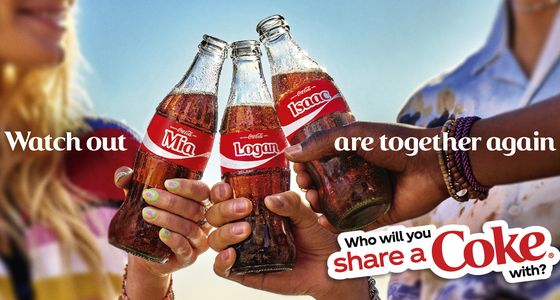
Ogilvy’s answer was to remove the Coca-Cola logo — one of the most recognized wordmarks on Earth — from the bottle and replace it with something a teenager or 20-something would actually look for on a shelf: their own name.
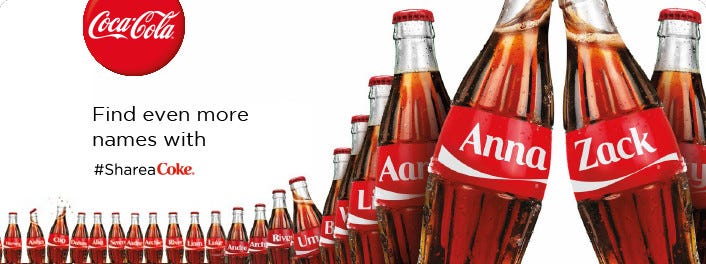
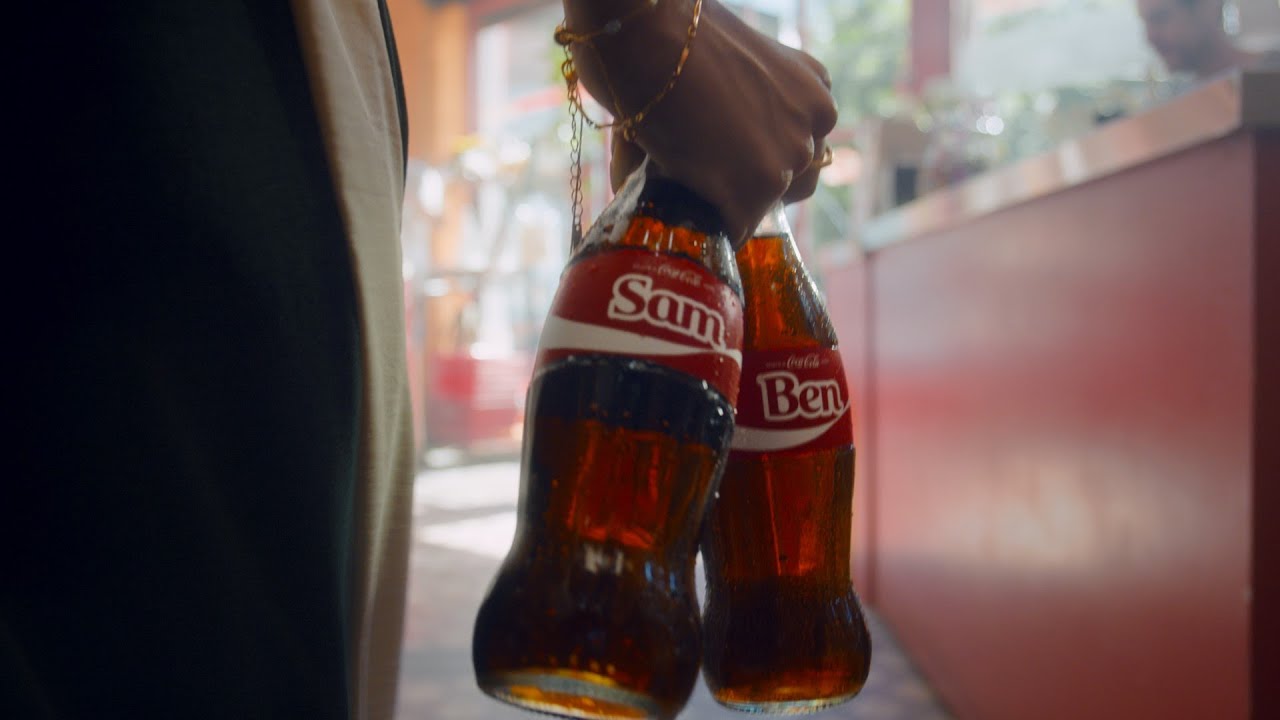
The campaign launched nationally on October 1, 2011, with 150 of the most common Australian first names printed on bottles and cans in Coke’s signature Spencerian script.
It was, by design, a low-tech idea executed with high-discipline production: no new formula, no new packaging shape, just a substitution on the label that forced people to physically scan shelves looking for themselves, a friend, or a family member — turning a routine grocery-aisle glance into a small search-and-find moment.
The Unglamorous Work Behind the Idea: A 5,287-Word Blacklist
Before a single bottle shipped, Coca-Cola’s risk and legal teams did work that rarely makes it into case studies: compiling a blacklist of more than 5,287 words and phrases to exclude from the name-personalization system, and running 225 individual trademark searches to make sure no chosen name infringed on existing marks.
That blacklist-based approach — flag a fixed list of bad words, allow everything else — worked reasonably well for a closed set of 150 pre-approved first names. It would prove far less durable once Coca-Cola opened the system up to open-ended, user-typed text years later.
Why It Worked: Personalization as Attention, Not Just Novelty
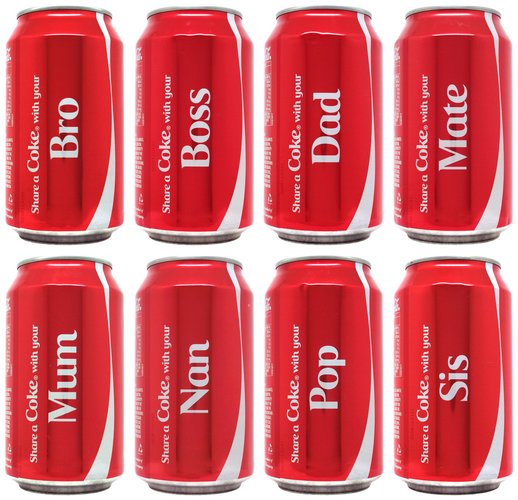
The insight behind Share a Coke wasn’t really about names — it was about attention. A can with “Coca-Cola” printed on it is wallpaper; a can with your own name, or your best friend’s, is something you pick up, photograph, and hand to somebody. Coca-Cola widened the net almost immediately by printing relationship labels alongside first names — “Mate,” “Bestie,” “Soulmate,” “Papa” — so people without a matching name on the shelf still had a reason to buy one and give it away.
Execution: Packaging, Kiosks, and an Early Digital Layer
Beyond the redesigned packaging, Coca-Cola built a companion website where visitors could search for a name, generate a virtual personalized can, and share it directly to social media — a digital layer that turned a shelf product into shareable content before that was standard practice.
The company also ran pop-up kiosks and experiential events where people could personalize a physical bottle on the spot, and backed the whole thing with a conventional TV, print and outdoor push carrying the hashtag #ShareACoke.
The Results: What Actually Happened to Sales in 2011-2012
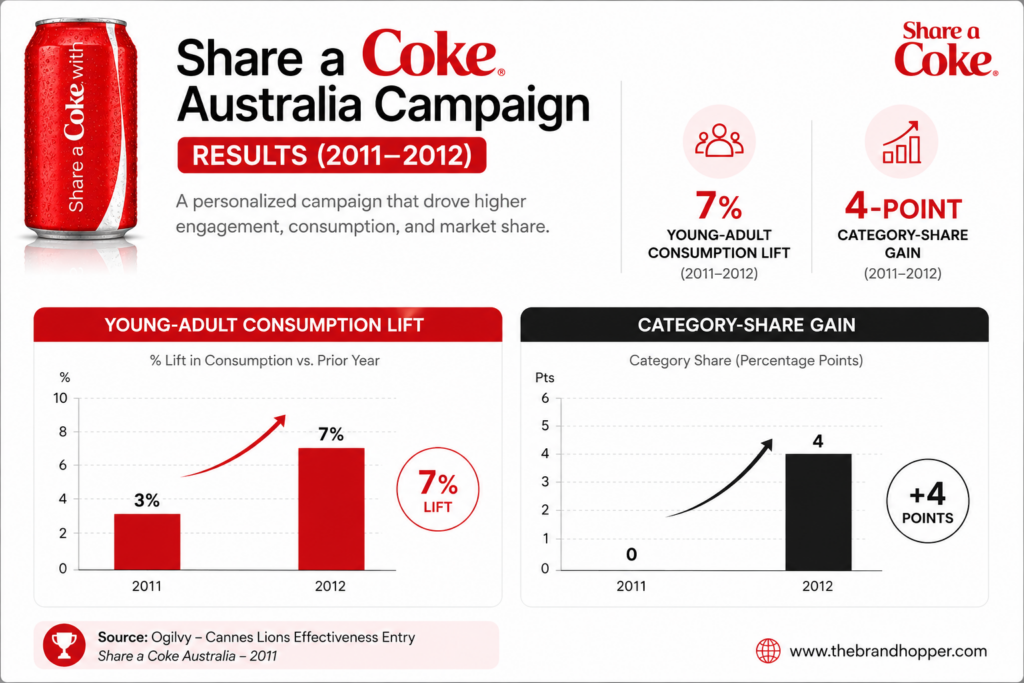
Ogilvy’s own post-campaign figures, later cited in its Cannes Lions effectiveness entry, credited Share a Coke with a 7% increase in Coca-Cola consumption among young adults in Australia and a 4-point gain in the brand’s category share — a real reversal after a decade of slow decline.
The following year, Coca-Cola brought the idea to the United States and other major markets, where it was credited with reversing roughly ten years of declining per-capita Coke consumption and lifting sales by more than 2%.
Going Global: Scaling to 80+ Countries
Given results like that, Coca-Cola scaled Share a Coke aggressively: by the mid-2010s it was running in more than 80 countries, each localized rather than simply translated.
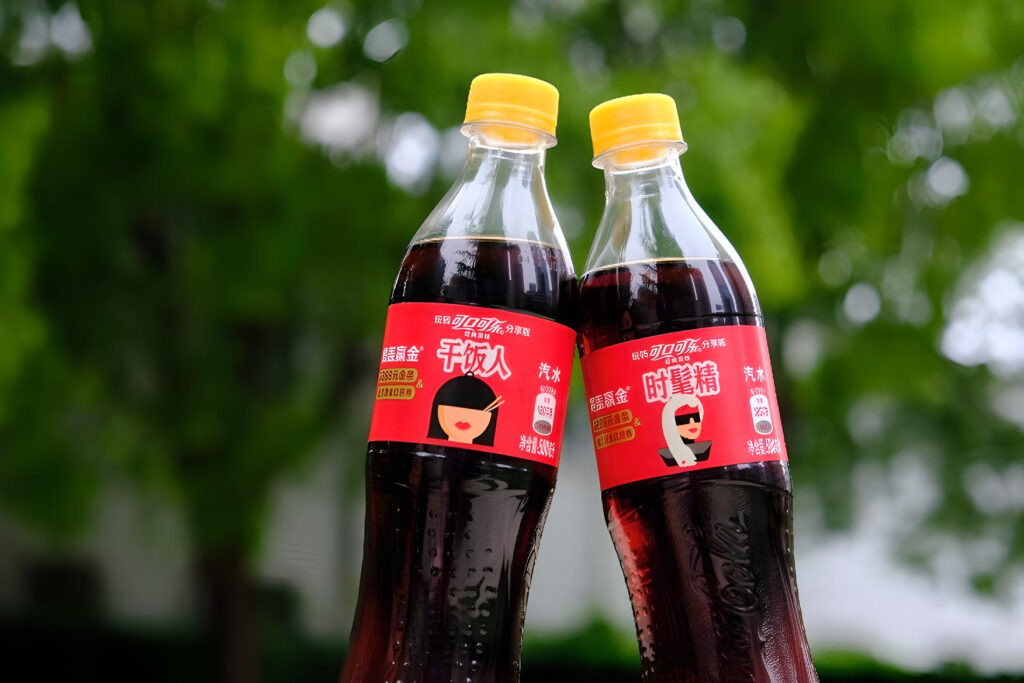
In China, where family names conventionally precede given names, Coca-Cola printed bottles family-name-first. In markets with non-Latin scripts, names were transliterated rather than dropped.
The consistency wasn’t the specific 150 names from Sydney — it was the underlying mechanic of swapping the logo for something personal, rebuilt locally market by market.
2013: Cannes Lions Recognition
In 2013, Ogilvy & Mather Sydney won its first-ever Creative Effectiveness Lion at the Cannes Lions International Festival of Creativity for Share a Coke — recognition specifically for a campaign’s business results, not just its creative concept, which made it a meaningful data point for a category (packaged food and beverage) that struggles to prove marketing ROI.
2014: The “Isis” Name Controversy
The first real controversy came in 2014, when Dutch shelves stocked bottles printed with the name “Isis” — a common Dutch girl’s name that, by then, had also become shorthand for the terrorist organization dominating headlines out of Iraq and Syria.
Coca-Cola pulled the name from production once the coincidence was pointed out, an early sign that a name-personalization system built around “is this name popular” hadn’t been built to ask “could this name mean something else by the time it ships.”
2021: Open Text, and the First Moderation Crisis
As Share a Coke matured, Coca-Cola experimented with letting people type their own custom text rather than choosing from a pre-approved name list — a shift from a closed system to an open one.
In a summer 2021 US promotion allowing up to 36 characters of custom label text, that shift exposed the limits of a fixed-blacklist approach: reporting at the time found the moderation filter blocked phrases like “Black Lives Matter” and “Gay Pride” while approving “White Lives Matter” and “I am Hitler.”
Coca-Cola apologized and adjusted the filter, but the underlying problem — a blacklist built for a few hundred names now guarding an open text field — hadn’t actually been solved, just patched.
2024: The Controversy Repeats
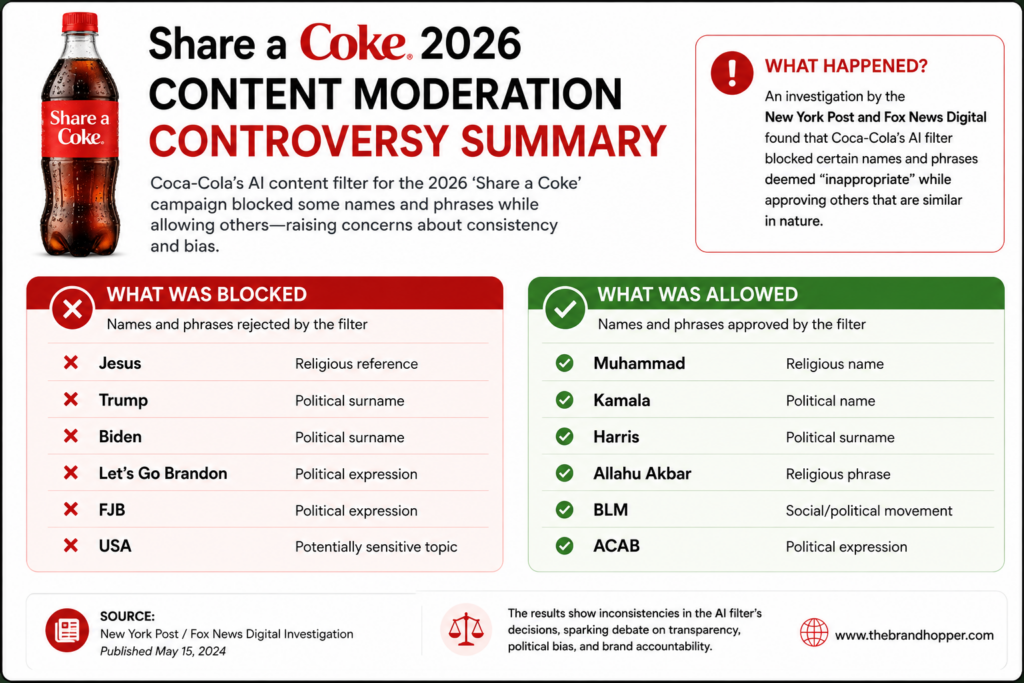
It resurfaced in September and October 2024, when social media users found the customization tool blocking “Jesus” and “Trump 2024” while allowing “Satan,” “Allah” and “Harris Walz 2024” through — a pattern independently confirmed by fact-checking outlet Snopes as a real quirk of the tool’s automated restrictions on religious and political terms, not a hoax or a doctored screenshot.
2025: The Gen Z Relaunch
None of that stopped Coca-Cola from doubling down on personalization for the campaign’s 2025 relaunch.
Announced March 26, 2025 and rolling out globally from April, the refreshed Share a Coke targeted Gen Z specifically, pairing physical personalized cans and bottles with a QR-code-linked digital hub, an AI-powered “Share a Coke Memory Maker” that generated more than 120,000 personalized videos for fans, a short film called “The Magic of Sharing,” influencer partnerships, and “Share a Meal” bundles with McDonald’s in select markets.
“The iconic Share a Coke is back and supercharged at a global level, celebrating the pure magic that happens when people connect,” said Islam ElDessouky, Coca-Cola’s Global VP of Creative, in the company’s own announcement.
The rolling rollout ultimately covered more than 120 countries. In the US specifically, personalized cans and bottles returned to retail shelves starting March 31, 2025, alongside CokeStore.com, where fans could order custom-etched glass bottles or $9.95 personalized 12-ounce cans directly.
Coca-Cola also placed physical customization kiosks in high-traffic tourist locations — including Orlando, Las Vegas, and the World of Coca-Cola museum in Atlanta — letting visitors print a can on the spot rather than order online and wait.
August 2026: Personalization Paused, Again
Then, in August 2026, the pattern repeated a third time. An investigation by Fox News Digital, reported by the New York Post, found Coca-Cola’s can-customization filter blocking phrases including “Jesus Is Lord,” “Black Lives Matter,” “Allah Is Lord” and “Free Palestine” while allowing “Pedophile Pride,” “God Is Dead,” “Proud Boys,” “Stand With Israel” and “Defund the Police” through unblocked.
The same investigation found the filter could be bypassed entirely by adding spaces between letters or swapping numbers for letters. Coca-Cola disabled the tool’s real-time order preview, paused new personalized orders while it investigated what it called a technical issue, and reiterated that all submitted text is reviewed again after checkout, before anything is physically printed — meaning a rejected-looking web preview and a final, approved order aren’t necessarily the same thing.
Why the Filter Keeps Failing
The recurring failure has a fairly mundane technical explanation. Share a Coke’s moderation was originally built to check a closed set of a few hundred pre-approved names — a problem simple exact-match blacklists handle well.
Opening the system to freely typed phrases turned that into an open-text content-moderation problem, the same category of problem large social platforms spend hundreds of millions of dollars a year on, with dedicated trust-and-safety teams, and still get wrong regularly.
A word list tuned for one marketing promotion doesn’t generalize to context, sarcasm, coded language or intentional workarounds — which is exactly the gap that’s now surfaced in 2021, 2024 and 2026.
The August 2026 reporting made the mechanism especially clear: reporters found they could get a blocked phrase through simply by adding a space between two letters or swapping a letter for a lookalike number, a trick that defeats exact-match filtering but wouldn’t fool a human reviewer or a more context-aware system for even a second.
That gap between what an automated filter catches and what a person would catch is, in miniature, the entire content-moderation problem the tech industry has spent the last decade trying to solve.
Data & Results
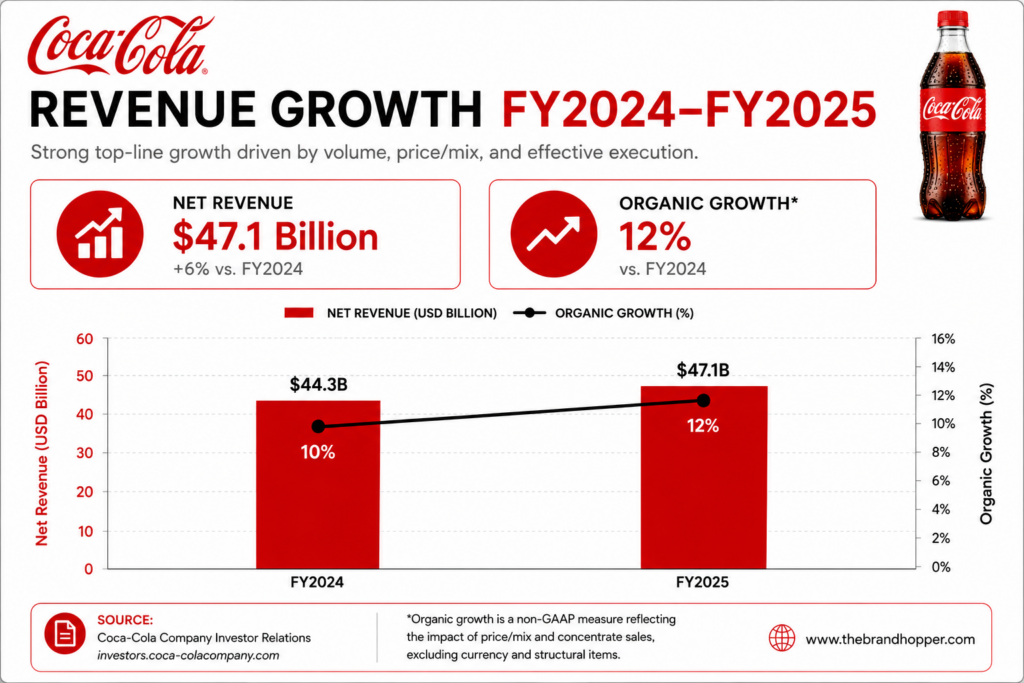
The Coca-Cola Company reported full-year 2025 net revenues of $47.9 billion, up 2% year-over-year, with organic revenue (non-GAAP) growth of 5% — its broader business context as Share a Coke enters its 15th year as an active, recurring platform rather than a one-off campaign.
Share a Coke’s 2025 relaunch reached more than 120 countries, up from roughly 80 countries at the campaign’s mid-2010s peak.
The Share a Coke Memory Maker AI tool generated over 120,000 personalized videos for fans during the 2025 relaunch alone.
Ogilvy Sydney’s original 2011 push was credited with a 7% rise in young-adult Coke consumption and a 4-point category-share gain in Australia; the US launch reversed roughly a decade of declining per-capita consumption.
Lessons for Marketers
1. Personalization scales faster than moderation does. Share a Coke’s core idea — swap the logo for a name — has aged extremely well; its execution keeps tripping over the same open-text-moderation problem because the brand keeps expanding what customers can type without proportionally rebuilding how that text gets reviewed.
2. A blacklist is not a policy. Every documented moderation failure here (2021, 2024, 2026) came from the same root cause: a fixed list of banned words applied inconsistently to a much larger space of possible meanings, rather than a coherent, testable policy for what the brand will and won’t print.
3. Real business results are still the best effectiveness case. Ogilvy’s Cannes-winning submission worked because it led with hard numbers (a 7% consumption lift, a 4-point share gain) rather than impressions or sentiment — a template worth copying for anyone building a case for a personalization or UGC campaign today.
4. Global scale requires real localization, not translation. Printing Chinese names in family-name-first order, rather than forcing a Western given-name-first template onto every market, is a small detail that’s a large part of why the campaign traveled to 120+ countries instead of stalling at the first non-English-speaking one.
5. A 15-year-old campaign can still be a live, breaking news story. Most “case study” campaigns are safely finished; Share a Coke generated a real news cycle the same month this article was updated, which is itself worth noting for anyone assuming a campaign’s story is over once the launch case study gets written.
Frequently Asked Questions
Q. What was the Share a Coke campaign?
A. Share a Coke is a Coca-Cola marketing campaign, launched in Australia in October 2011 by agency Ogilvy & Mather Sydney, that replaced the Coca-Cola logo on bottles and cans with popular first names and relationship labels (like “Bestie” or “Mate”), encouraging people to buy and share a personalized Coke.
Q. Is Share a Coke still running today?
A. Yes. Coca-Cola relaunched Share a Coke globally in 2025, targeting Gen Z with a QR-code digital hub, an AI-powered “Memory Maker” video tool, and a rollout spanning more than 120 countries — making it one of the longest-running personalization campaigns in consumer packaged goods.
Q. Did Share a Coke actually increase sales?
A. Yes, based on figures Ogilvy submitted for its Cannes Lions effectiveness award: a 7% rise in young-adult Coca-Cola consumption and a 4-point category-share gain in Australia, plus a reversal of roughly a decade of declining per-capita Coke consumption after the US launch.
Q. Why did Coca-Cola pull the name “Isis” from Share a Coke?
A. “Isis,” a common Dutch first name featured on bottles sold in the Netherlands in 2014, was removed from production after the terrorist organization ISIS made international headlines that year, creating an unintended and unwanted association.
Q. What is the Share a Coke content moderation controversy?
A. On at least three occasions (2021, 2024 and August 2026), Coca-Cola’s can-personalization tool was found to inconsistently block some names and phrases (including religious and political terms) while allowing others through, prompting apologies, filter adjustments, and — in 2026 — a pause on new personalized orders while the company investigates.
Q. What awards has Share a Coke won?
A. Ogilvy & Mather Sydney won a Creative Effectiveness Lion at Cannes Lions 2013 for Share a Coke — its first Creative Effectiveness win — specifically recognizing the campaign’s measurable business impact.
Q. What’s new in the 2025-2026 Share a Coke campaign?
A. The 2025 relaunch added an AI-powered Memory Maker tool (120,000+ personalized videos generated), a “The Magic of Sharing” short film, McDonald’s meal-bundle tie-ins, and a rollout to 120+ countries; in August 2026, Coca-Cola paused new personalized orders after a content-moderation investigation.
Q. Where can I still personalize a Coke can or bottle in 2026?
A. As of this update, Coca-Cola has paused new online personalized-can orders while it reviews its moderation filter, though CokeStore.com and in-person kiosks in cities including Orlando, Las Vegas and Atlanta had been active earlier in the relaunch; check Coca-Cola’s official channels for current availability before ordering.
Conclusion
Share a Coke is a genuinely rare case: a 2011 packaged-goods campaign that is still commercially active, still expanding into new markets and formats, and still capable of making news for reasons that have nothing to do with nostalgia.
The core idea — that your own name on a product is worth more attention than a famous logo — has proven durable enough to survive a decade and a half of format changes, from a fixed list of 150 Australian names to an AI video generator making six-figure volumes of personalized content.
What hasn’t kept pace is the unglamorous back-end work of moderating what an open text field lets people type, and that gap has now produced three separate viral controversies in five years. For marketers, that’s the real lesson sitting alongside the more flattering one: a personalization campaign is only as strong as the review process behind it.
Also Read: A Case Study on Taco Bell’s “Think Outside the Bun” Campaign
To read more content like this, subscribe to our newsletter